Aeolidiella alderi is a species of nudibranch belonging to the family Aeolidiidae. Its scientific name honors the British naturalist Joshua Alder, who made significant contributions to the study of marine molluscs. This species is widely distributed along the northeastern Atlantic coasts, from the British Isles to the Mediterranean, commonly found in shallow waters and intertidal zones, especially on sandy and rocky bottoms where its main food sources are available.
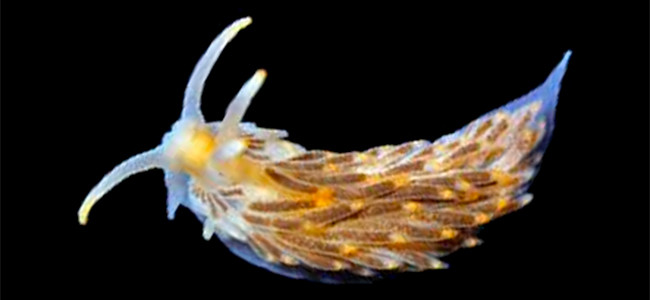
Morphologically, Aeolidiella alderi can reach a length of up to 4 cm, making it a moderately sized nudibranch. Its body is elongated and narrow, with numerous cerata (finger-like structures) arranged in rows along its back. These cerata are characteristically grayish or light brown, with white or yellow tips, giving it a translucent appearance. The body itself is whitish or pale orange in tone, and the rhinophores (sensory organs located on the head) are smooth and prominent. A distinctive feature of Aeolidiella alderi compared to similar nudibranchs, such as Aeolidia papillosa, is its smaller size and more orderly arrangement of cerata, along with less contrasting coloration patterns.
Regarding its feeding habits, Aeolidiella alderi is specialized in feeding on sea anemones, particularly species of the genera Actinia and Sagartia. It uses its radula, a tongue-like structure with small teeth, to scrape the stinging cells (nematocysts) from the anemones, which it then incorporates into its own cerata as a defense mechanism. This ability to steal and store nematocysts is a phenomenon known as kleptocnidy, common among aeolid nudibranchs. This behavior not only allows it to protect itself from predators but also makes Aeolidiella alderi a specialized predator in marine environments.
The reproduction of Aeolidiella alderi is hermaphroditic, as is common in nudibranchs, meaning each individual possesses both male and female reproductive organs. During mating, both individuals exchange sperm, allowing them to fertilize their own eggs. Subsequently, each individual deposits egg masses in the form of spiral ribbons on hard substrates such as rocks or algae. The larvae that hatch are planktonic and swim freely before settling and metamorphosing into juveniles, completing their life cycle.
An interesting aspect of Aeolidiella alderi is its ability to handle the nematocysts of its prey without being harmed, showing a fascinating evolutionary adaptation to avoid injury from the chemical defenses of anemones. Although this species is not as visually striking as other brightly colored nudibranchs, it plays an important role in the marine ecosystems where it is found, helping to control anemone populations and contributing to the biodiversity of the seafloor.
Photos: