
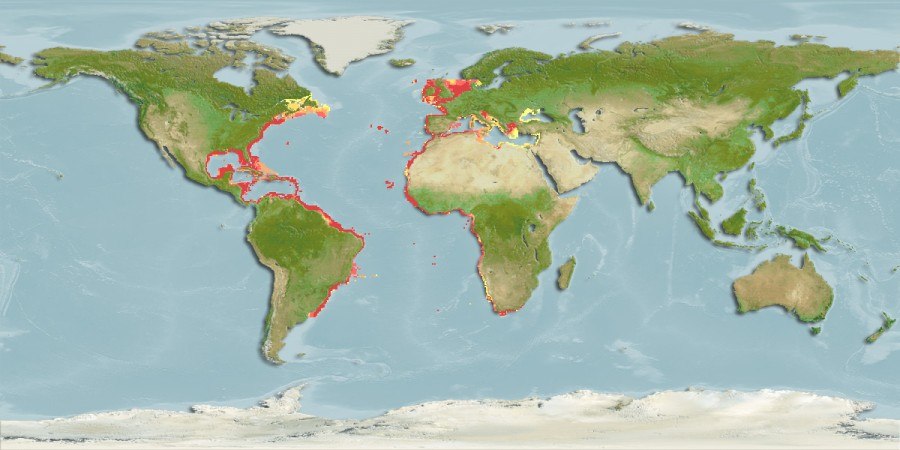
Balistes capriscus, commonly known as the grey triggerfish, is a marine fish from the family Balistidae. The genus name Balistes comes from Latin and refers to the resemblance of the fish’s dorsal fin mechanism to a ‘trigger‘, as it can raise and lock the first dorsal spine in position. The specific epithet (capriscus) alludes to its goat-like (Capra) behavior, being territorial and aggressive. This species is found in the western Atlantic from northern United States to Argentina, and in the eastern Atlantic from the British Isles to Angola, including the Mediterranean Sea. It inhabits rocky and coral bottoms, as well as sandy areas near reefs, at depths ranging from 10 to 100 meters.
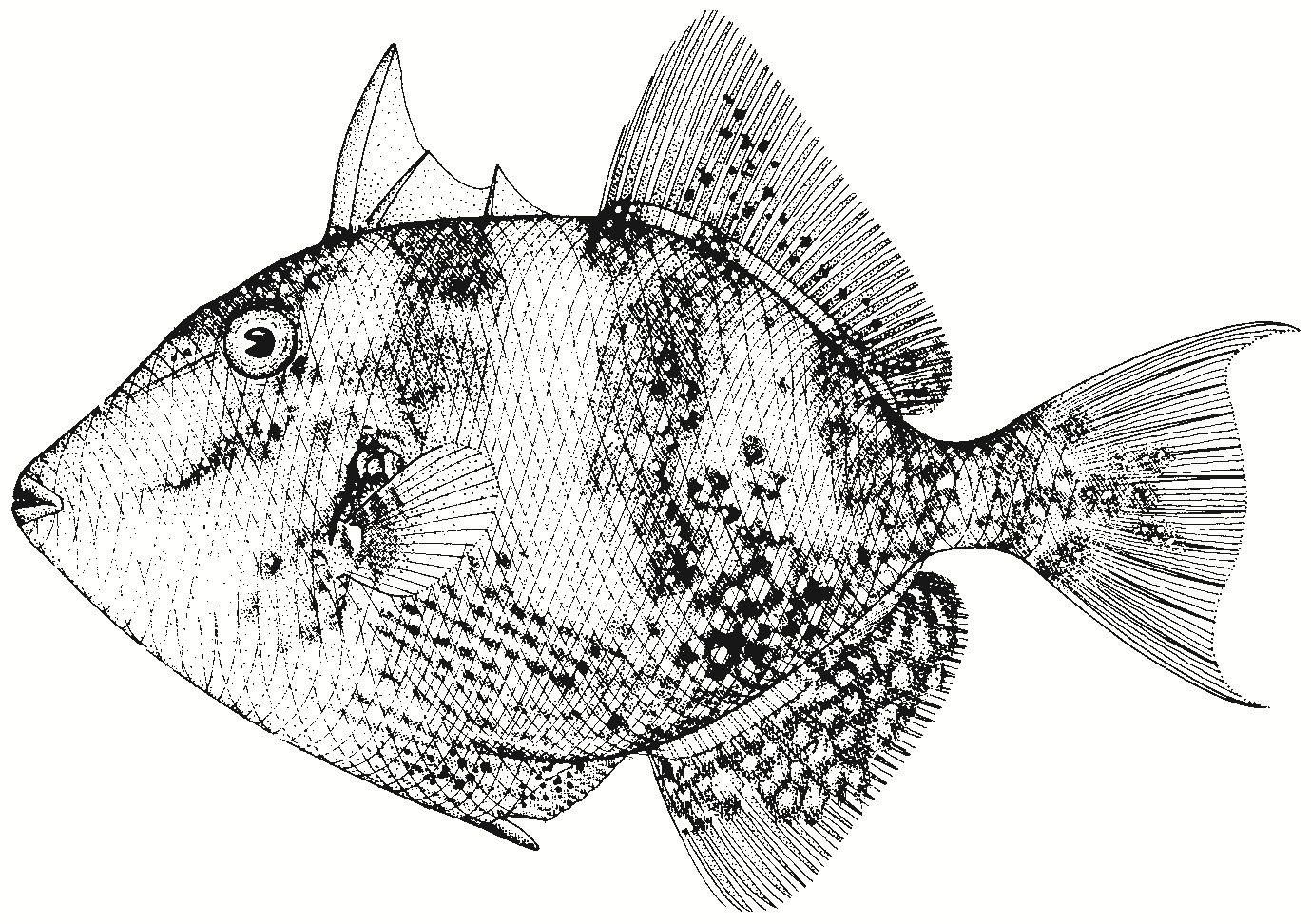
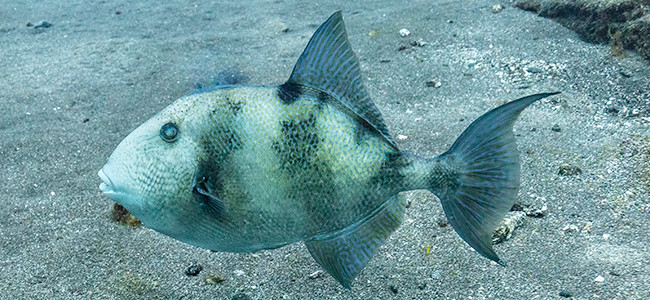
The Balistes capriscus has a laterally compressed, diamond-shaped body, reaching up to 60 cm in length, though most common specimens measure between 30 and 40 cm. Its coloration is grayish or light brown, darker on the upper body and lighter on the belly. The skin is covered with small tough scales, giving it a rough and protective texture. One of its most distinctive features is the spiny dorsal fin: the first spine is large and can be raised and locked vertically as a defense mechanism. It also has strong teeth used to crush the shells of molluscs and crustaceans, its main food source.
Regarding its diet, the grey triggerfish is carnivorous and feeds on a wide variety of benthic invertebrates. Its diet mainly includes crustaceans like crabs and shrimps, molluscs such as clams and mussels, as well as echinoderms like sea urchins. Thanks to its powerful teeth, it can easily crush hard shells. This feeding behavior makes it an efficient predator in its environment, contributing to controlling invertebrate populations in its ecosystems. It has also been observed feeding on smaller fish, although this is less common.
The reproductive behavior of Balistes capriscus occurs mainly during the warm spring and summer months. During the breeding season, males prepare nests on sandy bottoms or among rocks, where females lay their eggs. After spawning, males aggressively guard and protect the nest until the eggs hatch, showing very marked territorial behavior. Fertilization is external, and larvae are planktonic during early life stages, dispersing with currents until settling on the bottom.
An interesting fact about the grey triggerfish is its defensive behavior. When threatened, this fish can retreat into crevices or small cavities where it raises its dorsal spine to lock itself in place, making it extremely difficult for predators to extract it. It is also known to be aggressive if provoked, especially during breeding season, so caution is advised if you encounter one. Additionally, it is of interest in both sport and commercial fishing due to the quality of its meat, although its thick, scaly skin makes preparation more labor-intensive.
Photos:
 from
from