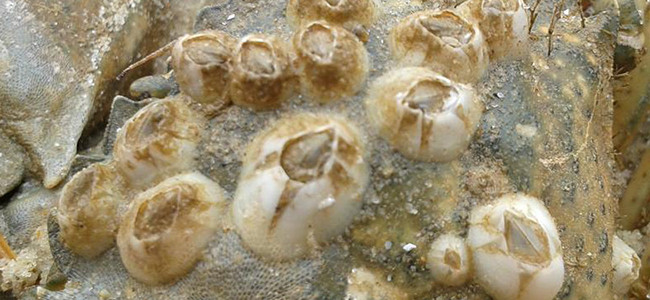
Balanus spp, commonly known as acorn barnacles, are a group of cirripede crustaceans belonging to the family Balanidae within the order Sessilia. The generic name (Balanus) comes from the Greek ‘balanos‘, meaning ‘acorn‘, a reference to their rounded, compact shape resembling the fruit. These species are sessile organisms, meaning they remain attached to hard surfaces throughout their adult life. They are found in marine environments worldwide, from the intertidal zone to deeper waters, adhering to rocks, shells, ship hulls, artificial structures like platforms and docks, and even other marine organisms such as whales and turtles.
Morphologically, Balanus species have a shell composed of white or grayish calcareous plates forming a conical or cylindrical structure. Size varies considerably depending on the species, but some individuals can measure between 1 and 7 cm in height. The shell is made up of six main plates surrounding a central opening, which is covered by an operculum-like structure that opens when the organism feeds. The cirri, feather-like appendages similar to legs, extend from inside the shell to capture small suspended food particles. A distinguishing feature that helps differentiate Balanus species from other similar genera, such as Chthamalus, is the structure and arrangement of the calcareous plates and the size of the body.
Balanus spp are suspension filter feeders, meaning they feed on small organic particles and planktonic organisms carried by ocean currents. They use their cirri to capture phytoplankton, zooplankton, bacteria, and other microorganisms. This feeding is passive, as they rely on currents to bring food to them, although they can actively move their cirri to enhance capture.
Reproduction in Balanus spp is sexual, and these organisms are simultaneous hermaphrodites, meaning they possess both male and female reproductive organs. However, they require nearby individuals to reproduce, as they do not self-fertilize. Fertilization is internal, and the eggs are released into the water after developing inside the individual. The larvae, known as nauplii, are planktonic and go through several developmental stages before settling on a suitable surface, where they metamorphose and become sessile adults.
An interesting fact about Balanus spp is that due to their ability to adhere to nearly any hard surface, they are a major concern in marine biofouling, affecting the performance of ships and underwater structures. On vessels, the accumulation of these organisms can increase drag, resulting in higher fuel consumption. Additionally, some species of Balanus, such as Balanus glandula, can have significant ecological impacts by competing with other species for space and resources in coastal areas.
Photos: