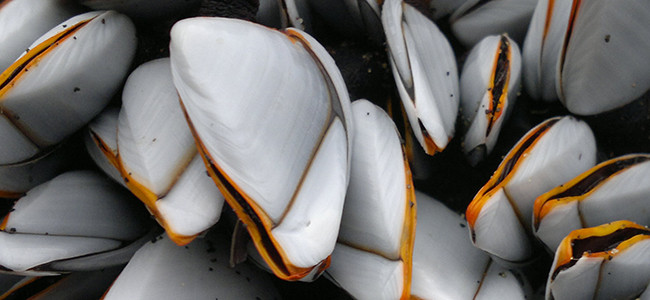
Lepas anatifera, commonly known as the goose barnacle or pelagic barnacle, is a cirripede crustaceans from the family Lepadidae. The scientific name derives from ‘Lepas‘, Greek for ‘barnacle‘ or ‘shell‘, and ‘anatifera‘, from Latin meaning ‘duck-bearing‘, a reference to the old mistaken belief that geese were born from these barnacles, due to their superficial resemblance and shared habitat. It is a sessile marine organism that typically lives attached to drifting objects such as logs, buoys, or even ship hulls. Its distribution is cosmopolitan, found in oceans worldwide in warm and temperate waters.
Lepas anatifera has an elongated body that can reach up to 10 cm in length, covered by a series of white or grayish calcareous plates on the upper part, forming a protective structure. The body is divided into two main parts: a long, flexible, fleshy stalk that attaches it to the surface, and a capitulum covered by the plates. The stalk is dark brown or blackish and can be as long as or longer than the body. This feature distinguishes it from other cirripedes, such as those in the genus Balanus, which do not have such a long stalk. A similar species, Lepas anserifera, can be confused with Lepas anatifera, but differs in having a shorter stalk and broader plates.
This pelagic barnacle is a suspension filter feeder, feeding on small planktonic organisms and suspended particles in the water. Its cirri, which are long, feathery appendages, emerge from the calcareous plates when feeding, capturing plankton carried by ocean currents. Its diet consists mainly of phytoplankton, zooplankton, and suspended organic matter.
Regarding reproduction, Lepas anatifera is a simultaneous hermaphrodite, meaning each individual has both male and female reproductive organs, although they cannot self-fertilize. Cross-fertilization occurs via a long, flexible penis that reaches nearby individuals. The fertilized eggs are incubated inside the barnacle’s body until they are released into the water as nauplius larvae, which go through several planktonic developmental stages before settling and transforming into juveniles.
An interesting fact about Lepas anatifera is its historical connection to the medieval legend of the ‘barnacle geese’ or Branta leucopsis. It was believed that these migratory geese did not reproduce in the usual way, but instead emerged from barnacles, due to their presence in the same regions and their similar appearance. Additionally, Lepas anatifera is an important biological indicator in oceanographic studies, as its presence on certain floating objects can reveal patterns of ocean currents and the dispersion of marine debris.
Photos: