Pachygrapsus crassipes, commonly known as the striped shore crab or rock striped crab, is a species of decapod crustaceans belonging to the family Grapsidae and the order Decapoda. The genus name Pachygrapsus comes from the Greek ‘pachy‘ (thick) and ‘grapsus‘ (crab), referring to the robust shape of its body. The word crassipes is derived from Latin and means ‘thick legs‘, referencing its well-developed limbs. This species is native to the western coast of North America, ranging from Oregon (USA) to Baja California (Mexico). It has also established populations on the western Pacific coast (Japan and Korea) since the late 19th century, likely introduced via zoea larvae transported in ship ballast water. Pachygrapsus crassipes inhabits rocky intertidal zones, from the upper to lower shore, preferring hard substrates with crevices, loose stones, and moderately coarse sand.
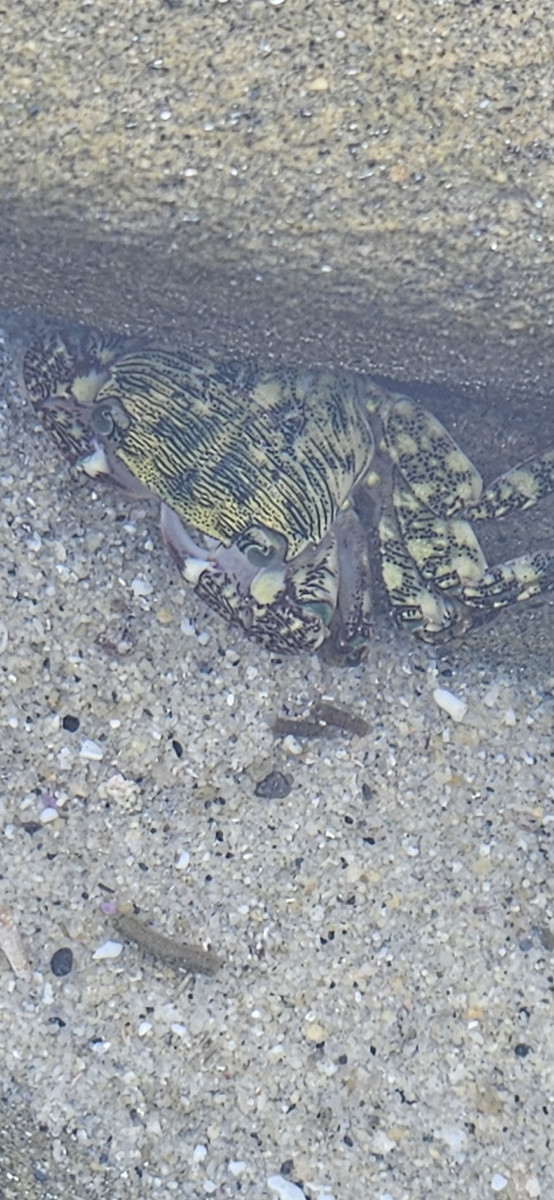
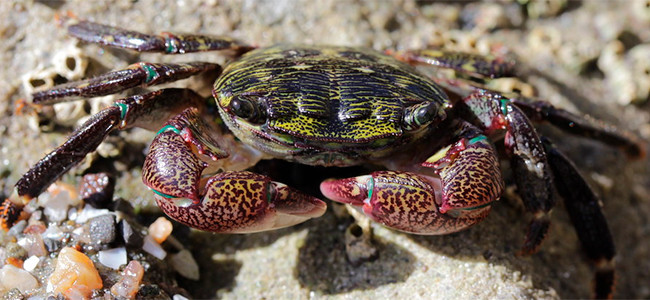
Morphologically, this crab has a square-shaped carapace, wider than it is long, reaching up to 47.8 mm in males and 40.8 mm in females. Its coloration ranges from brown to purple or black, often featuring distinctive green stripes on the carapace. The claws (chelipeds) are reddish or purplish with mottled and striped patterns on the upper surface, and lighter underneath. The legs show purple and green tones, also mottled in appearance. A distinctive feature of the species is the presence of visible horizontal lines on the carapace. It can be confused with Pachygrapsus transversus, but Pachygrapsus crassipes is distinguished by its darker coloration and the pronounced stripes on its carapace.
Pachygrapsus crassipes is an opportunistic omnivore. Its diet includes green algae such as Ulva and Enteromorpha, red algae like Endocladia and Grateloupia, and brown algae such as Fucus. It also consumes diatoms, worms, mussels, dead fish, limpets, snails (Littorina, Tegula), hermit crabs, isopods, and even conspecifics, especially after molting when their exoskeletons are still soft. Dietary preferences vary by habitat: in rocky shores, nocturnal predation dominates, while in tidepools, algae are consumed more during the day.
Reproduction is sexual. Males reach sexual maturity at 7 months (12 mm carapace width), and females between 11 and 12 months (15 mm carapace width). Ovigerous females are observed between April and September, and while typically there is one reproductive cycle per year, occasionally there may be two. A single female can carry up to 50,000 eggs under her abdomen, which develop through larval stages (zoea, megalopa) before becoming juveniles. There is a direct relationship between carapace size and age, and individuals can live up to three or four years.
Among its notable traits, Pachygrapsus crassipes is a semi-terrestrial species highly adapted to the intertidal environment. It can remain out of water for up to 70 hours, returning periodically to moisten its gills. It is a solitary and territorial species that displays aggressive intraspecific behavior, though it does not defend fixed territories. Conflicts are usually resolved by size, with larger individuals prevailing. It forms social hierarchies in densely populated habitats. The species also has excellent vision both during the day and at night. During the megalopa stage, larvae are active swimmers and use coastal currents for dispersal, orienting themselves by the water’s surface. Its predators include seabirds, octopuses, rats, raccoons, and fish.
Photos: