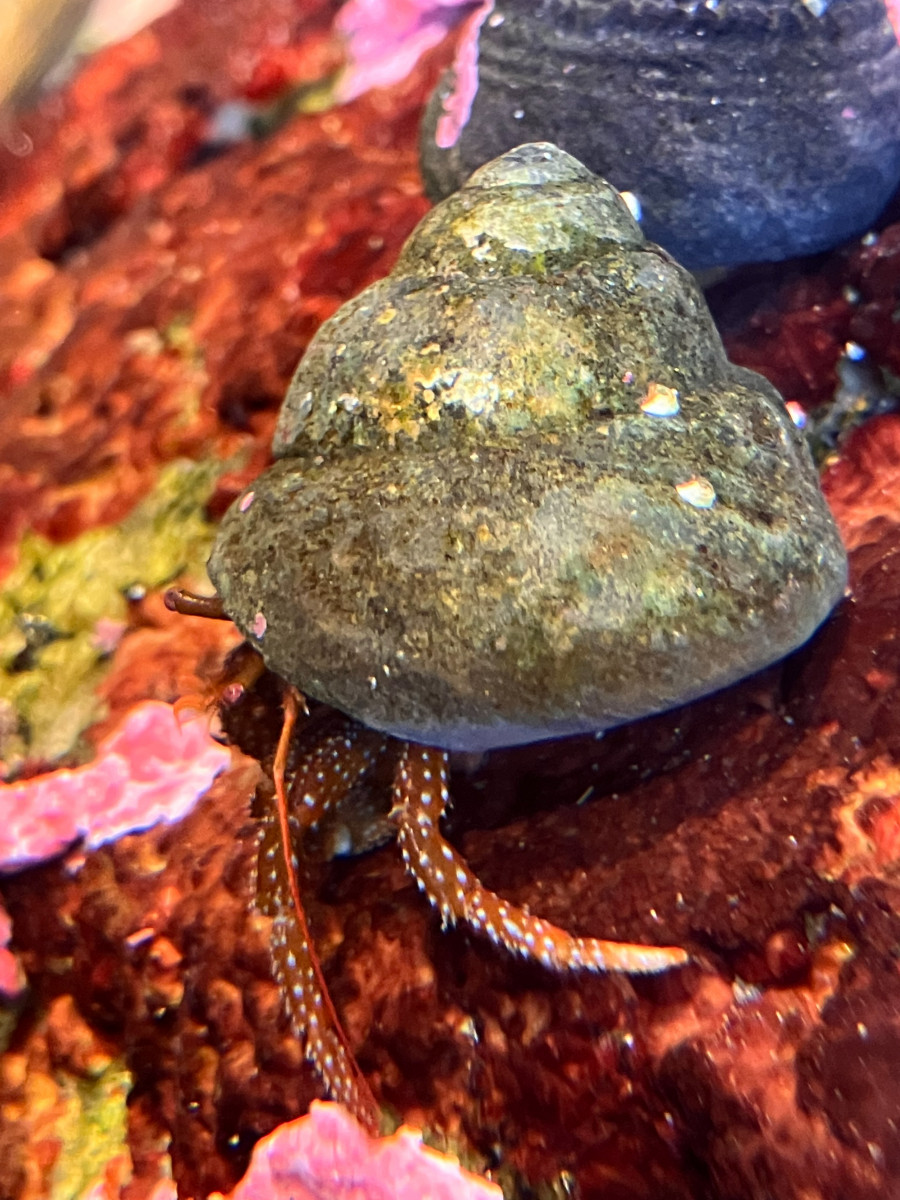
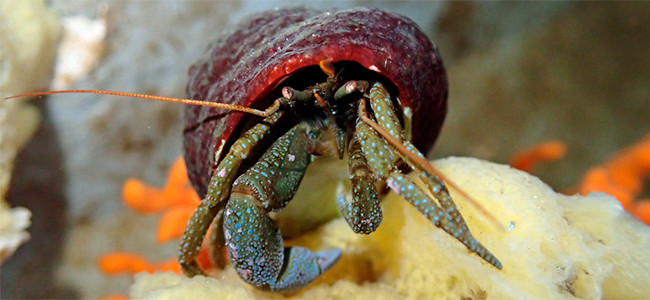
Pagurus granosimanus, commonly known as the granular hermit crab, is a species of decapod crustaceans in the family Paguridae, widely distributed along the northeastern Pacific coast, from the Aleutian Islands in Alaska to Bahía de Todos Santos in Baja California, Mexico. The genus name Pagurus comes from the Greek ‘pagouros‘, meaning ‘tail-bearer‘, referring to the soft, coiled tail typical of hermit crabs. The specific epithet granosimanus refers to the granular or rough texture of its chelipeds. This species inhabits lower intertidal zones and depths down to 36 meters, commonly found on rocky bottoms, among pebbles, or within algae, where it shelters inside empty mollusc shells.
Morphologically, Pagurus granosimanus is easily recognized by the raised light blue spots on its chelipeds and walking legs — a unique feature among common intertidal hermit crabs in its range. It also has unbanded orange or red antennae. In juveniles, the legs may appear yellow. The carapace can reach up to 1.9 cm in length. Unlike similar species such as Pagurus beringanus (which has red bands on its legs) or Pagurus hirsutiusculus (which has hairy legs but no blue spots), Pagurus granosimanus stands out visually due to its spotted blue pattern. It may also be confused with Pagurus hemphilli, which has dark red legs with yellow spots, and Pagurus samuelis, which features a blue band on legs 2 and 3 and is found only on open coasts.
This hermit crab is omnivorous and feeds mainly in the late afternoon and at night. Its diet includes algae, organic detritus, small invertebrates, and animal remains. It lives in mollusc shells such as Tegula funebralis, Nucella lamellosa, and Searlesia dira, while smaller individuals often use Littorina shells. It prefers shells into which it can fully retract, offering protection from predators like the fish Xiphister atropurpureus.
Regarding reproduction, Pagurus granosimanus shows seasonal reproductive cycles, with up to three broods per year. Females carry the fertilized eggs under their abdomen for about 55 days. After hatching, the larvae go through planktonic stages (zoea and megalopa) lasting around 70 days before metamorphosing into juvenile crabs This larval development allows for wide dispersal through ocean currents.
A curious trait of this species is its behavior regarding shell use. While it may change shells more frequently than species like Pagurus hirsutiusculus, it also clings to its current shell with greater tenacity. In fact, Pagurus granosimanus has been observed forcibly evicting other hermit crabs to take over their shells. Additionally, this species can be found in large aggregations on shallow sandy bottoms, which contrasts with the typically solitary image of hermit crabs. It does not tolerate brackish water well and is therefore restricted to stable marine salinity environments.
Photos: