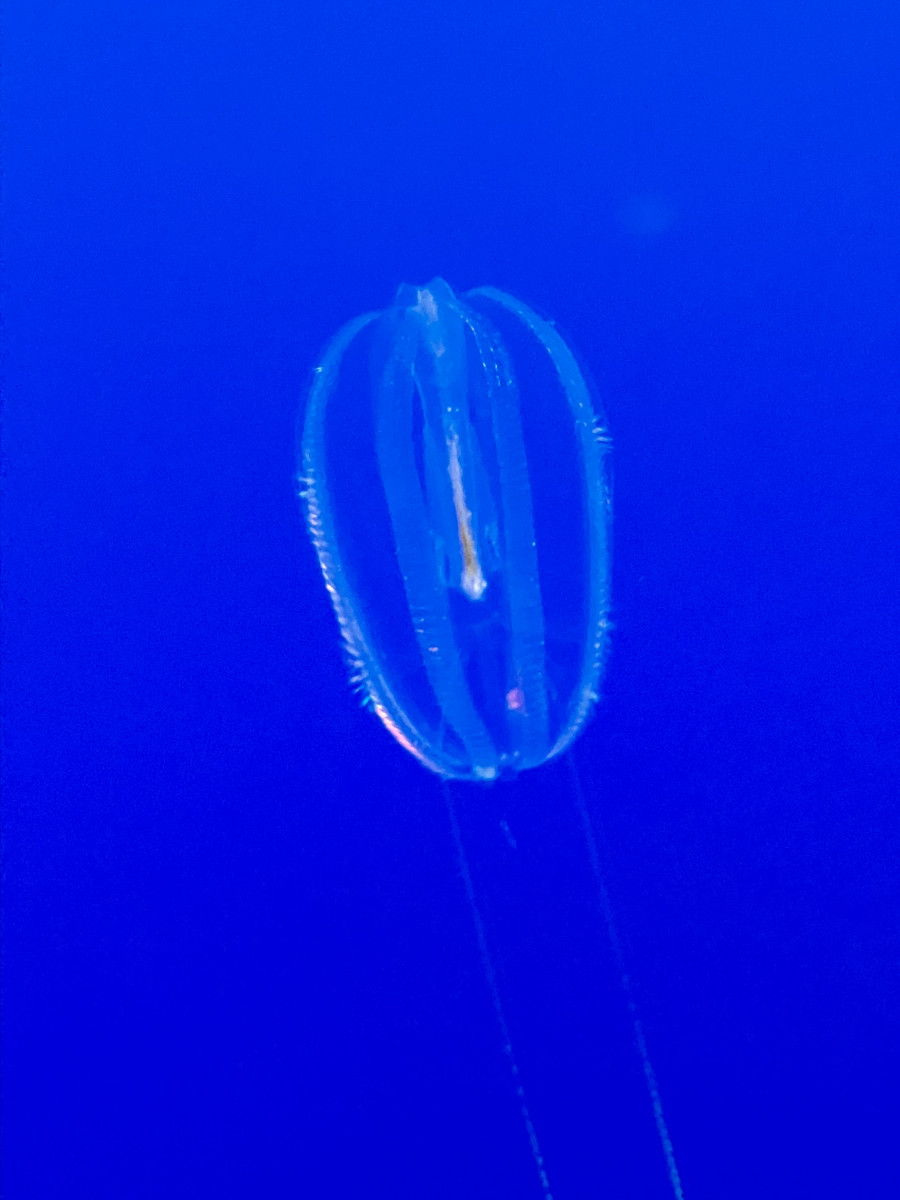
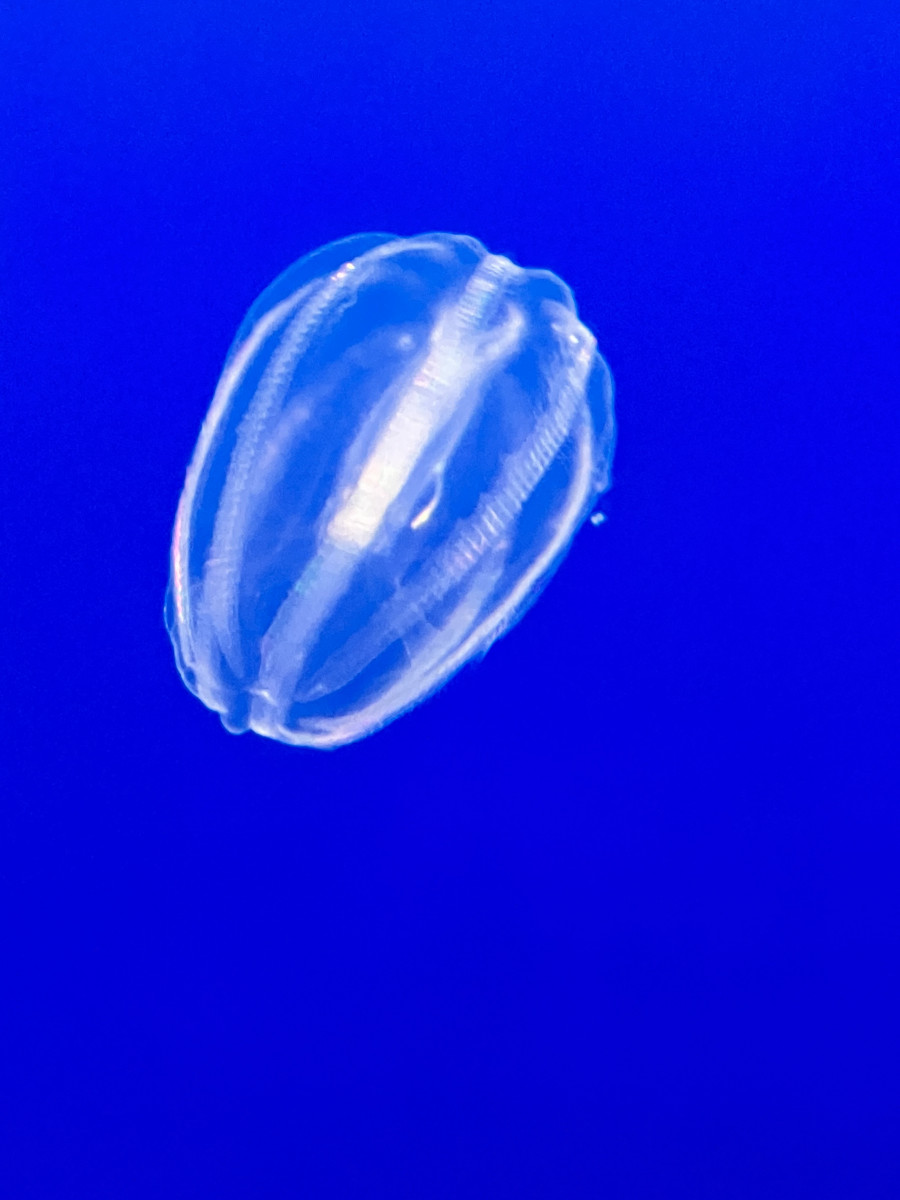
Hormiphora californensis, commonly known as the California comb jelly or Californian sea gooseberry, is a species of ctenophores belonging to the family Cydippidae and the phylum Ctenophora. The genus name Hormiphora comes from the Greek ‘hormos‘ (collar) and ‘phoros‘ (bearing), in reference to its globular shape and its crown of ciliated combs. The species was described from Californian waters, as indicated by the epithet californensis. It inhabits subtropical pelagic zones of the eastern Pacific Ocean, especially off the coast of California, and can be found from the surface down to depths of 200–280 meters, as recorded in Monterey Canyon using remotely operated vehicles (ROVs).
Hormiphora californensis has a spherical or slightly ovate, transparent, and gelatinous body, ranging in size from a few millimeters to several centimeters in length. Its most characteristic feature is the eight longitudinal bands of cilia (combs) it uses to move through the water. These cilia refract light, creating a very distinctive iridescent effect. Unlike true jellyfish (Cnidaria), ctenophores do not possess stinging cells (cnidocytes). It can be differentiated from similar species such as Hormiphora plumosa by the arrangement and length of its ciliated combs and by details in the internal structure of its digestive apparatus, observable only through specialized imaging techniques.
Regarding its feeding, Hormiphora californensis is a planktivorous predator that mainly feeds on small crustaceans such as euphausiids (Euphausiacea), copepods, and larvae of other marine organisms. It employs retractile tentacles covered with adhesive cells called colloblasts to capture its prey, which are then directed to its mouth and digested in a simple gastric cavity. Its passive feeding system—based on contact with plankton—is efficient in the mid-ocean layers, where it typically moves slowly using its cilia.
Hormiphora californensis is a simultaneous hermaphrodite, meaning that each individual possesses both male and female reproductive organs. Fertilization is external, giving rise to eggs that develop into a planktonic larva morphologically similar to the adult. Throughout its development, this larva undergoes a gradual process of differentiation until it fully assumes the adult form. No specific reproductive season is known, although in stable marine environments it may reproduce continuously throughout the year.
An interesting fact about this species, and about ctenophores in general, is its evolutionary significance. Recent genomic studies led by researchers at UC Santa Cruz and MBARI have shown that ctenophores, including Hormiphora californensis, represent the oldest animal lineage to have diverged from the rest of the animal kingdom. This suggests that complex structures such as the nervous and digestive systems may have evolved independently in different animal groups. Ecologically, H. californensis plays an important role in the marine food web as a predator of zooplankton and possibly as prey for mesopelagic fish. Although no specific symbiotic relationship has been documented, its presence is strongly influenced by the availability of planktonic prey and local oceanographic conditions.
Photos: