
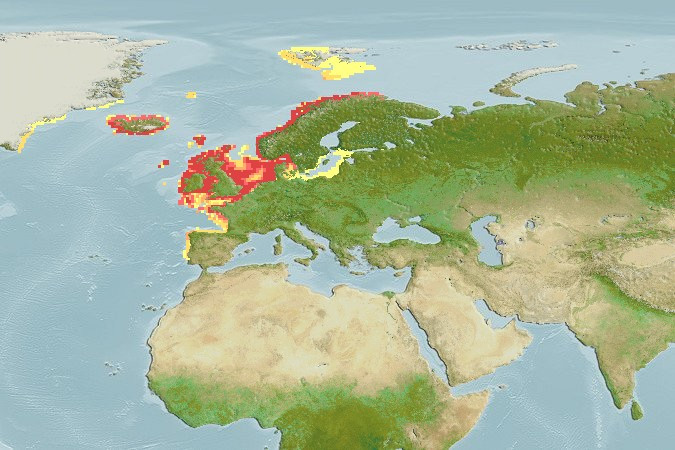
Echinus esculentus, commonly known as the edible sea urchin, is a species of echinoderms belonging to the family Echinidae. Its scientific name derives from the Greek ‘echinos‘, meaning ‘urchin‘ or ‘spine‘, and ‘esculentus‘, which in Latin means ‘edible‘, referring to its tradition as a food source in some cultures. This species inhabits cold waters of the northeastern Atlantic, from the coasts of Norway and the North Sea to the Mediterranean Sea, being particularly common along the coasts of the United Kingdom, France, and the Iberian Peninsula. It is found in rocky areas and mixed gravel or sandy bottoms at depths ranging from 0 to 1200 meters, though it is most frequent between 10 and 200 meters.
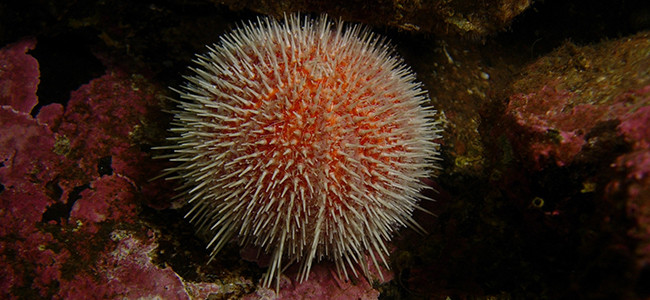
Echinus esculentus has a rounded, globular body, with a diameter that can reach up to 15 cm, although its size varies depending on the region. Its shell or ‘test‘ is covered with movable spines, which can be reddish, purple, pink, or pale green. These spines, used for protection from predators and for movement along the seafloor, are relatively short compared to those of other sea urchins. In addition to spines, it possesses small pedicellariae, pincer-like structures that help it defend itself and keep its surface clean of organisms. The urchin also has hundreds of tube feet, which are small retractable tubes that allow it to adhere to surfaces and move slowly. Compared to other species of urchins, such as Strongylocentrotus droebachiensis, Echinus esculentus has a larger shell and shorter spines.
Echinus esculentus is primarily herbivorous, feeding on algae that it scrapes from rocks using its complex mouth structure known as the ‘Aristotle’s lantern‘, made up of five teeth. In addition to algae, it also consumes small invertebrates such as sponges, bryozoans, and cnidarians polyps, making it a generalist consumer. Its role as an herbivore is important in marine ecosystems, as it helps control the overgrowth of algae on rocky bottoms.
The reproduction of Echinus esculentus is sexual, with separate sexes (dioecious). During spring and summer, both males and females release their gametes into the water, where external fertilization takes place. The resulting larvae are planktonic and go through several developmental stages before settling on the seabed and metamorphosing into juveniles. sea urchins have a high regenerative capacity and can regenerate their spines and other lost structures, giving them a notable survival advantage in complex marine environments.
A curious fact about Echinus esculentus is that it has historically been consumed by humans, especially in some regions of Europe, where its taste and nutritional value were appreciated. However, its importance as a food source has decreased compared to other commercially valued species, such as Paracentrotus lividus. Additionally, due to its ecological role in regulating algae growth and its sensitivity to environmental changes, Echinus esculentus is considered a key bioindicator in marine conservation studies and in monitoring the effects of climate change on coastal ecosystems.
Photos:
 from
from