
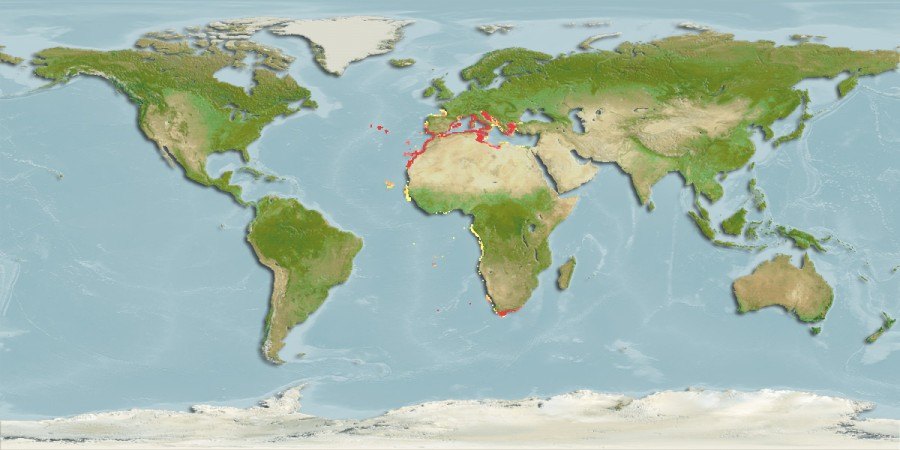
Marthasterias glacialis, commonly known as the spiny starfish or spiny sea star, is a species of echinoderms belonging to the family Asteriidae. The genus name (Marthasterias) derives from the Greek ‘martha‘ (maiden) and ‘aster‘ (star), while ‘glacialis‘ refers to the cold habitats where it can be found, such as the northeastern Atlantic waters. Its geographic distribution ranges from the coasts of Norway to the Mediterranean Sea, including the western European and northwestern African coasts. It inhabits rocky areas and mixed seabeds, from the intertidal zone down to depths of approximately 200 meters.
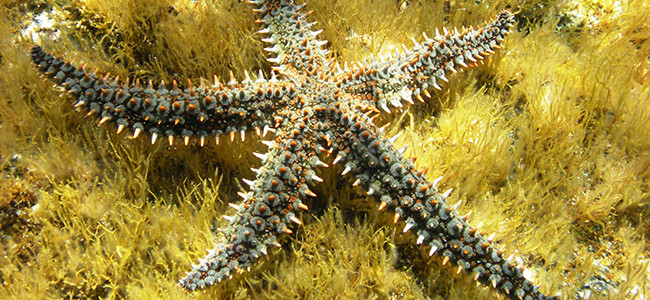
Morphologically, Marthasterias glacialis can reach a diameter of up to 70 cm, making it one of the largest sea stars. It is characterized by five long and robust arms covered with prominent spines, usually arranged in three main rows along each arm. These spines are white or light gray and surrounded by a crown of small pedicellariae, pincer-like structures that help it defend against predators. Its coloration ranges from greenish, brownish, and gray tones, often with brown or purplish spots. Compared to other sea star species, such as Asterias rubens, Marthasterias glacialis is easily distinguishable by its larger size and the density of spines on its arms.
Regarding its feeding habits, Marthasterias glacialis is an opportunistic predator. It primarily feeds on bivalves, such as mussels and clams, as well as sea urchins and other benthic invertebrates. To feed, it uses its powerful arms and tube feet to exert pressure and open the shells of bivalves. It then everts its stomach outside its body, inserting it into the mollusk’s shell to digest the prey externally. It can also act as a scavenger, feeding on dead animals or organic debris.
The reproduction of Marthasterias glacialis is sexual and usually occurs during the warmer months of the year, mainly in spring and summer. This species has separate sexes (dioecious), and both males and females release their gametes into the water, where external fertilization takes place. After fertilization, the planktonic larvae go through several stages before settling on the seafloor and metamorphosing into juvenile sea stars.
An interesting fact about Marthasterias glacialis is its ability to regenerate its arms if they are lost due to predators or accidents, a common trait among sea stars. This species also plays an important ecological role as a top predator in marine ecosystems, helping to regulate populations of other invertebrates. Additionally, the spines on its arms not only provide protection but also deter certain predators, such as some fish, from feeding on it.
Photos:
 from
from