
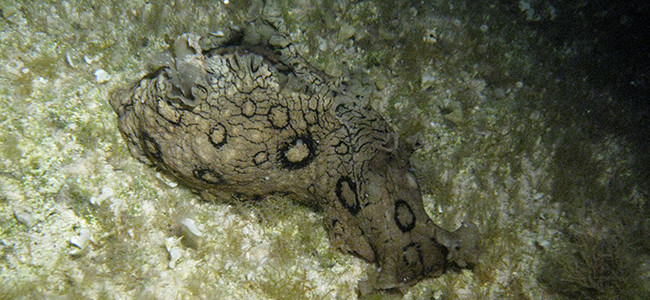
Aplysia dactylomela, commonly known as the ringed sea hare or spotted sea hare, is a gastropod belonging to the family Aplysiidae. Its scientific name derives from ‘dactylos‘ (Greek for ‘finger‘) and ‘melas‘ (meaning ‘black‘), referring to the distinctive dark ring-shaped spots decorating its body. This species is easily recognizable by these markings and its large, soft body. It is widely distributed in tropical and temperate seas worldwide, including the western Atlantic and the Mediterranean Sea, where it can be found in shallow coastal areas, among seagrass beds and rocky reefs.
Aplysia dactylomela is a large mollusc that can reach up to 40 cm in length and weigh several kilograms. Its body is elongated and soft, with two large parapodial lobes that resemble ‘wings’ and are used for undulating swimming. The coloration of its body varies, ranging from light brown to green, often with a grayish or yellowish tint, and featuring the characteristic black ring spots distributed across its skin surface. Unlike nudibranchs, sea hares have a small, rudimentary internal shell covered by the mantle. Aplysia dactylomela has a pair of ear-shaped rhinophores (sensory appendages) that help detect chemicals in the water and locate food. The presence of ring-shaped spots clearly distinguishes it from other species in the genus, such as Aplysia fasciata, which has a more uniform coloration without these distinctive patterns.
Regarding its feeding habits, Aplysia dactylomela is herbivorous and feeds mainly on algae, especially red and green algae. It uses its radula—a tongue-like organ covered with microscopic teeth—to scrape algae from rocks and other surfaces. Digestion of these algae enables the sea hare to extract compounds used in chemical defense, producing a purple or red ink when threatened. This defensive behavior helps confuse or repel predators like fish and crabs. Additionally, Aplysia dactylomela has been observed feeding on various algae depending on availability, granting it ecological flexibility in different environments.
The reproduction of Aplysia dactylomela is quite interesting, as it is a simultaneous hermaphrodite, meaning each individual possesses both male and female reproductive organs. During mating, one individual acts as a male and another as a female, but it is also common for them to form ‘chains’ where several individuals connect and alternate male and female roles. After fertilization, females lay long ribbons of eggs containing thousands of embryos in protected areas such as rock crevices or under algae. The eggs hatch into planktonic larvae that float in the water before settling on the seafloor and transforming into juveniles.
An interesting fact about Aplysia dactylomela is that it has been used in scientific research related to neurobiology and memory due to its relatively simple and large nervous system. Studies on learning and memory conducted with this species have significantly contributed to understanding complex biological processes in other animals, including humans. Furthermore, its ability to produce chemical defenses makes it an organism of interest for research in chemical ecology and biomedicine.
Photos:
 from
from