Felimare villafranca, formerly known as Hypselodoris villafranca, is a striking nudibranch belonging to the family Chromodorididae. The scientific name derives from ‘villa‘, which may refer to a geographic locality, and ‘franca‘, alluding to its discovery in Mediterranean waters. It is mainly distributed in the Mediterranean Sea and the eastern Atlantic, from the southern coast of Spain to the Canary Islands. It inhabits rocky bottoms and sponge-rich areas, its main food source, and is commonly observed in shallow waters, generally between 10 and 40 meters deep.
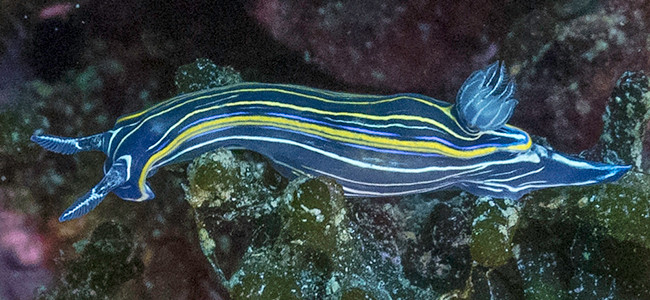
Felimare villafranca is characterized by its elongated and flattened body, which can reach 4–6 cm in length. It shows a very distinctive and vibrant coloration, with a dark or bright blue background body adorned with several longitudinal yellow lines running across its back. Along the mantle edge, there is usually a thin yellow or white line that outlines the body. The rhinophores (sensory appendages on the head) are dark blue and clearly ringed, a common trait among nudibranchs of the family Chromodorididae. The gills, located at the posterior part of the body, are plume-like and blue, also ringed with white. Compared to similar species such as Felimare picta, Felimare villafranca is smaller and displays a pattern of finer and more orderly lines on its back.
Regarding its diet, Felimare villafranca is specialized in feeding on marine sponges. It prefers sponges of the genus Dysidea, though it can also consume related species. These sponges contain toxic compounds that the nudibranch can assimilate, making it toxic to its predators. The ability to use the chemical compounds from its prey provides a natural defense, an example of what is known as ‘toxin sequestration.’ This also allows it to stand out in its environment by exhibiting aposematic (warning) coloration that informs predators of its toxicity.
Reproduction in Felimare villafranca follows the typical nudibranch pattern, as they are simultaneous hermaphrodites. This means each individual has both male and female reproductive organs, allowing reciprocal mating. After mating, they lay egg masses in gelatinous spirals on marine substrates like rocks or algae. The larvae that hatch are planktonic, allowing them to disperse with ocean currents before settling on the seabed and transforming into juveniles.
A curious fact about Felimare villafranca is its striking blue and yellow coloration, which not only serves as a warning to predators but is also a common trait among many species in the family Chromodorididae. Additionally, although nudibranchs are usually solitary, several individuals of Felimare villafranca can sometimes be seen in close proximity, especially in sponge-rich areas. This nudibranch is a fascinating example of how marine organisms develop complex defensive strategies by leveraging both the chemistry of their prey and the evolution of visual signals.
Photos: