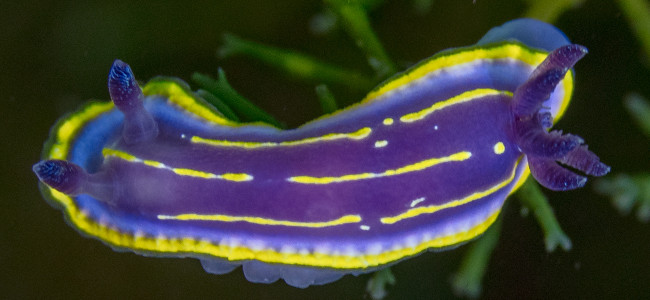
Felimida krohni is a nudibranch from the family Chromodorididae, known for its colorful appearance and habitat in the northeastern Atlantic and the Mediterranean Sea. The species name honors the German zoologist August David Krohn, who made important contributions to the study of molluscs. Felimida krohni is a frequent inhabitant of rocky and sandy bottoms, feeding mainly on sponges. It can be found in shallow waters, typically between 5 and 40 meters deep, although it has also been recorded at greater depths.
Morphologically, Felimida krohni has an elongated and flattened body, reaching lengths between 2 and 4 cm. Its coloration is one of its most distinctive features: the mantle is violet or purple with bright yellow spots or lines distributed across the dorsal surface. Along the mantle edges, there is a thin white or yellowish line. The rhinophores and gills, located at the posterior part of the body, are dark purple, contrasting with the body color. The rhinophores, ringed as in many other Felimida species, are sensitive to chemical stimuli in the water, helping the nudibranch locate food and detect other individuals of its species. Compared to related species like Felimida luteorosea, Felimida krohni shows a more uniform coloration pattern with less variation in violet tones.
Regarding its diet, Felimida krohni is a specialist in marine sponges, feeding by scraping their surface with its radula, a tongue-like structure covered with tiny teeth. Sponges from the genera Dysidea and Spongia are its primary food sources. Like other nudibranchs, Felimida krohni can sequester the toxins present in these sponges for its own defense, storing them in its body and becoming toxic to predators. Its bright coloration serves as an aposematic warning, signaling to potential predators its chemical defenses.
The reproduction of Felimida krohni follows the typical hermaphroditic pattern of nudibranchs. Individuals possess both male and female reproductive organs, allowing reciprocal mating. During copulation, they exchange sperm, and both subsequently deposit gelatinous spiral egg masses attached to rocks or other hard surfaces. The larvae that hatch are planktonic, allowing them to disperse in the water column before settling and metamorphosing into juveniles that will grow into adults.
An interesting fact about Felimida krohni is its ability to relatively quickly regenerate rhinophores or gills if damaged by predators. This is especially useful in environments with high competition and predation risk. Additionally, like other nudibranchs in its family, Felimida krohni can secrete a defensive substance when threatened, helping to repel attackers. Due to its specialized diet and striking coloration, this nudibranch is a fascinating example of the complex adaptations marine organisms develop to survive in competitive and diverse environments.
Photos: