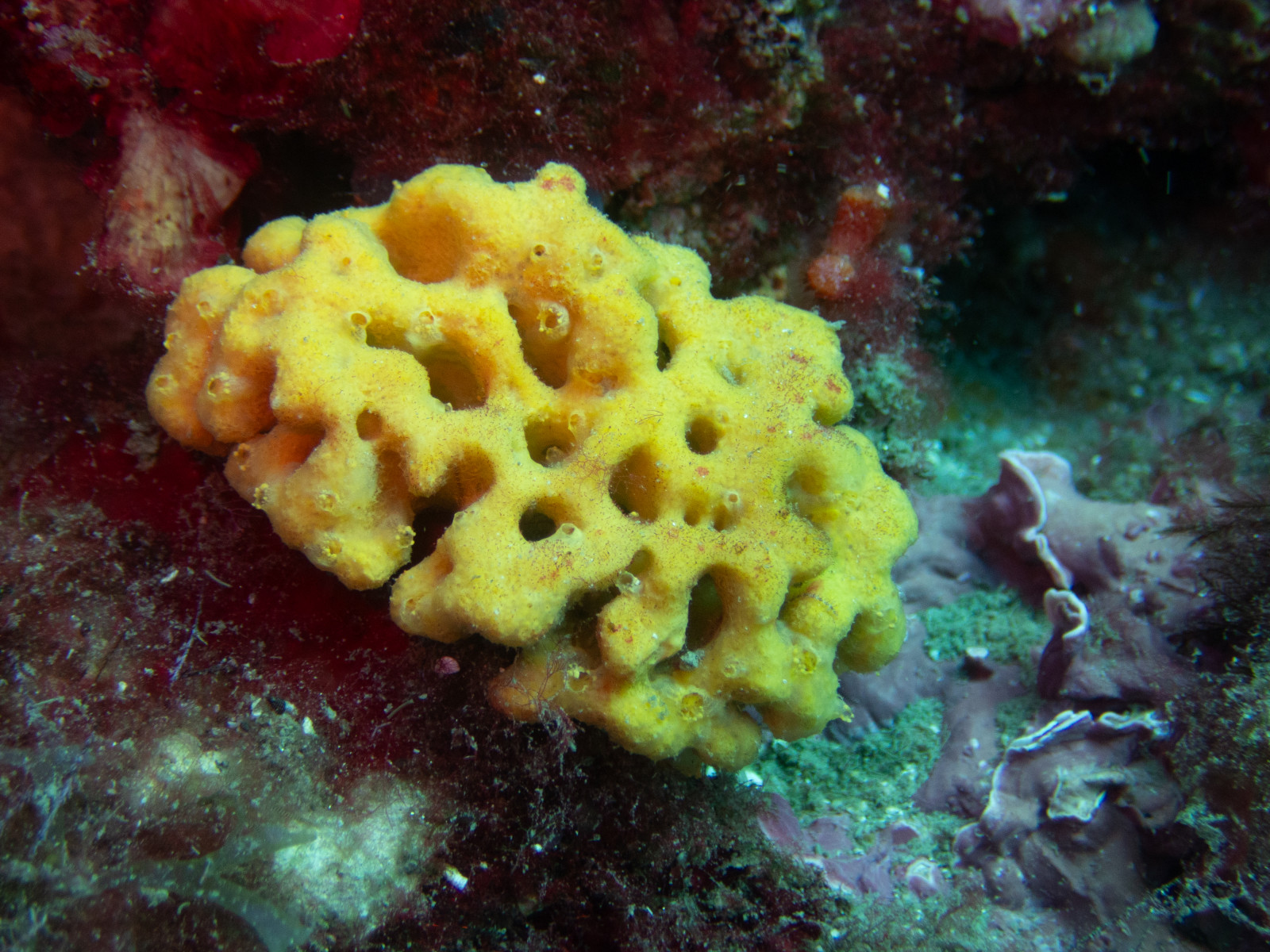
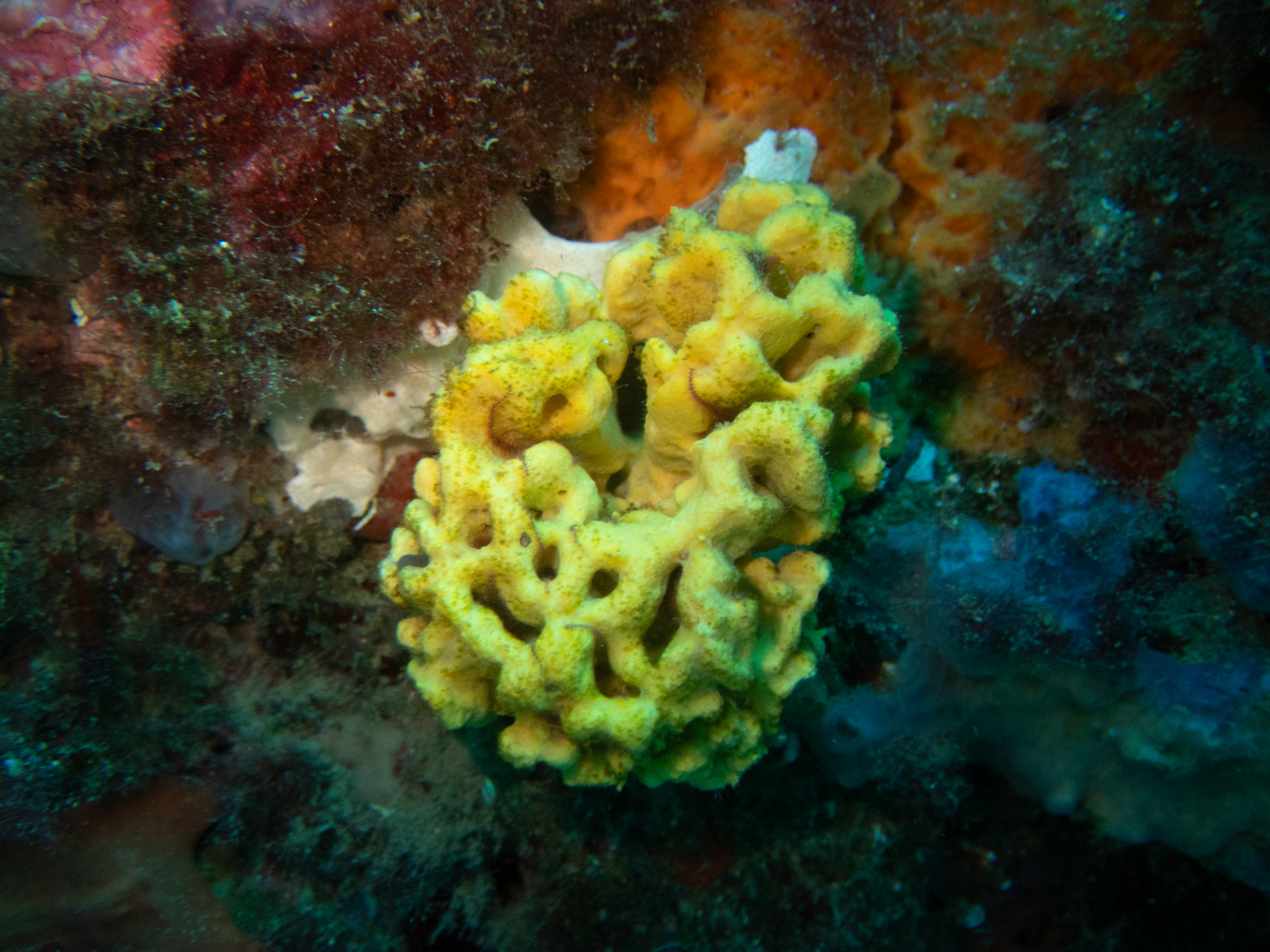
Axinella damicornis is a species of sponge belonging to the class Demospongiae, within the phylum Porifera. The genus name ‘Axinella‘ comes from the Greek ‘axine‘ meaning axe, referring to the shape of some structures of these sponges, while ‘damicornis‘ is derived from Latin and alludes to its ‘horn-like branching‘ form, as its appearance resembles branched coral or deer antlers. It is commonly known as the ‘horn sponge‘ due to this characteristic shape. Axinella damicornis is widely distributed in the Mediterranean Sea and the northeastern Atlantic Ocean, primarily inhabiting rocky areas and underwater walls between 10 and 50 meters deep. It prefers zones with moderate to strong currents that provide nutrients, allowing it to carry out its filter-feeding.
Axinella damicornis has a branched structure, with a body divided into several erect branches that can reach between 10 and 30 cm in height. These branches have a rough and sometimes spiny surface, and their color ranges from yellow-orange to brown. This bright coloration makes it easily recognizable in the rocky habitats where it resides. The sponge’s texture is relatively firm due to the presence of silica spicules that provide structural support. A distinctive feature that can help differentiate Axinella damicornis from other branched sponge species is the arrangement of its pores and oscula, which are irregularly distributed along the branches. This contrasts with similar species, such as Axinella polypoides, which usually show a more regular pattern in their surface structures.
Axinella damicornis is a filter-feeding sponge, meaning it feeds on particles suspended in the water, such as bacteria, small planktonic organisms, and organic matter. Water is pumped through its pores, and food particles are captured by specialized cells called choanocytes. The filtered water is then expelled through the oscula (larger openings). This process not only allows it to feed but also plays an important role in purifying the water in its environment.
The reproduction of Axinella damicornis can be both sexual and asexual. In sexual reproduction, the sponge releases gametes into the water where external fertilization occurs. The resulting larvae are planktonic and swim until they find a suitable substrate to settle and develop into a new sponge. It is also capable of reproducing asexually through fragmentation, where small parts of the sponge detach and can regenerate into complete individuals, a useful process in environments where sponges are susceptible to physical damage.
A curiosity about Axinella damicornis is its role in marine ecosystems as a habitat for a variety of organisms. The branches of this sponge provide refuge and support for numerous invertebrates, such as small crustaceans, annelids, and molluscs, which find protection within its complex structure. Additionally, sponges of this genus have been studied for their potential in producing bioactive compounds with antibacterial and antifungal properties, making them interesting from a biomedical perspective.
Photos: