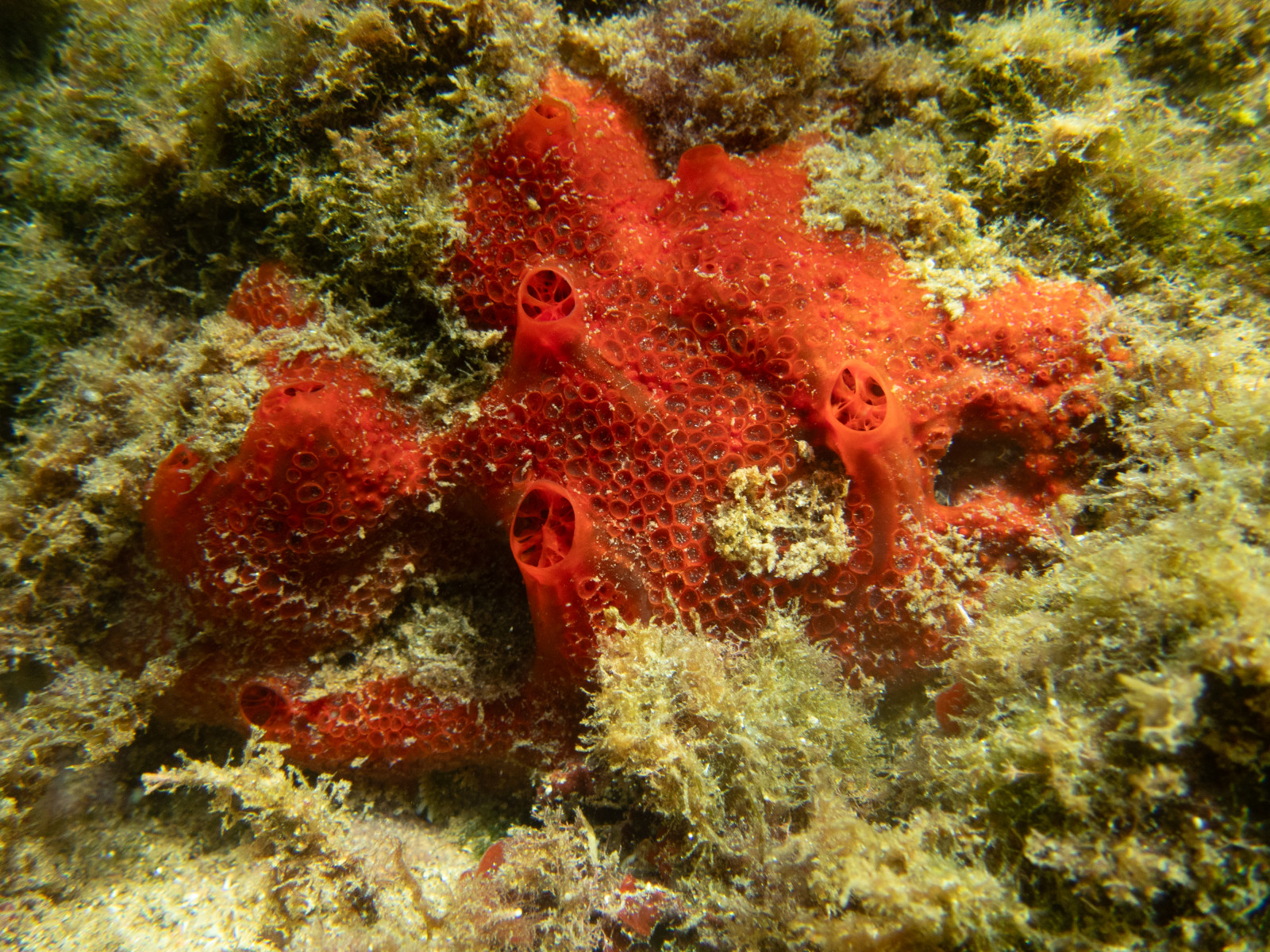
Phorbas fictitius (Bowerbank, 1866), commonly known as the red encrusting sponge, belongs to the family Hymedesmiidae within the order Poecilosclerida of the class Demospongiae. Its specific name ‘fictitius‘ comes from Latin, meaning ‘false‘ or ‘artificial‘, referring to the erroneous initial assignment to the genus Microciona, later corrected by Bowerbank. This species primarily inhabits rocky substrates in the infralittoral zone, in areas exposed to strong currents, where it attaches to vertical walls, beneath stones, and on shells. It is distributed throughout the northeastern Atlantic (Azores, Canary Islands, Madeira, and European coasts up to the North Sea) and the Mediterranean Sea, occurring in both the western and eastern basins. It is commonly found at depths of 20 to 60 meters in shaded areas with clear or moderately turbid waters.
This sponge exhibits two main morphologies: an encrusting form as a thin crust, and a massive-lobate form, developing cushion-like structures up to 14 mm thick and forming patches up to 30 cm in diameter. It has a soft, firm, and compressible consistency, with a smooth to slightly slippery surface marked by circular depressions 1–10 mm wide containing inhalant sieves. Its coloration ranges from gray to bright red, depending on water clarity and light, being typically bright red in clear waters and pale pink in turbid environments. A distinctive feature distinguishing it from similar species, such as Hemimycale columella, is the absence of white rims around depressions and the presence of oscula (exhalant openings) with raised, translucent margins.
Like all sponges, Phorbas fictitius is a filter feeder that obtains its food by continuously pumping water through its system of canals and pores. It filters volumes of water hundreds of thousands of times greater than its own volume in 24 hours. Its diet consists mainly of bacteria, microalgae, organic detritus, and other microscopic suspended particles. This efficient feeding mechanism not only sustains the sponge but also plays an important role in filtering and clarifying marine ecosystems where it occurs.
Reproduction in Phorbas fictitius can be both sexual and asexual. Most individuals are hermaphroditic, producing both eggs and sperm, although populations with separate sexes have also been described. Asexual reproduction occurs through fragmentation, where a portion of the sponge detaches and gives rise to a genetically identical individual. In sexual reproduction, sperm released into the water are drawn in through the pores of another sponge, where they fertilize internal eggs. The resulting planktonic larvae disperse with the currents before settling on a suitable substrate to complete their development.
An interesting aspect of Phorbas fictitius is its marked color variability, directly influenced by water transparency and available light, providing an adaptive advantage across different habitats. Like other sponges, it plays an important ecological role as a biofilter and as a refuge for small invertebrates that live in symbiosis or as commensals, including amphipod crustaceans and bristle worms. Although lacking commercial value, this species is a significant component of benthic communities, contributing to biodiversity and the stability of marine ecosystems.
Photos: