
Spirastrella cunctatrix is a species of marine sponge belonging to the class Demospongiae, within the family Spirastrellidae. Its scientific name derives from Latin: ‘Spira‘, meaning spiral, and ‘strella‘, referring to the arrangement of its skeletal spicules in star or spiral shapes. The term ‘cunctatrix‘ means ‘delayed‘ or ‘late‘, possibly alluding to its slow growth nature. This sponge inhabits the temperate seas of the eastern Atlantic and the Mediterranean, commonly found in shaded and rocky areas such as caves and underwater crevices, from the intertidal zone down to depths of about 50 meters. It thrives in areas with low light and moderate currents, which provide ideal conditions for its development.
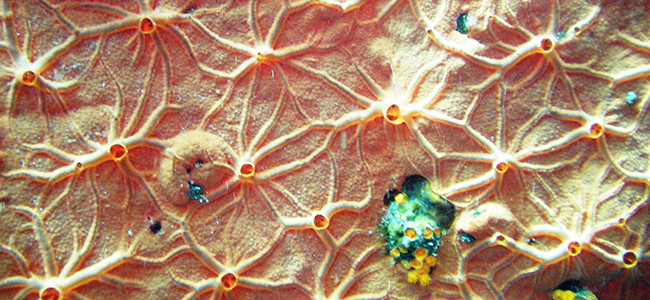
Spirastrella cunctatrix is easily recognizable by its massive shape and bright coloration, which varies between shades of red, orange, and occasionally pink or violet. Its texture is firm and somewhat rough to the touch due to the calcareous spicules that form its internal skeleton, providing rigidity. The sponge’s surface is perforated by numerous oscula and pores used to filter water and capture food particles. The size of Spirastrella cunctatrix can vary, reaching several centimeters in thickness and covering rocky surfaces up to 30 cm or more. Compared to similar sponges such as Chondrosia reniformis, Spirastrella cunctatrix is more colorful and has a rougher texture.
Regarding its feeding, like most sponges, Spirastrella cunctatrix is a filter feeder. It consumes small suspended particles such as bacteria, phytoplankton, and dissolved organic matter in the water. Through an internal canal system, the sponge pumps large amounts of water, filtering food via specialized cells called choanocytes. This process not only allows it to obtain nutrients but also plays an important role in water quality within marine ecosystems by clarifying water through the removal of suspended particles.
The reproduction of Spirastrella cunctatrix can be both sexual and asexual. In sexual reproduction, it is hermaphroditic, meaning a single individual produces both eggs and sperm. Fertilization is internal, and larvae are released into the water, where they swim freely for a short period before settling on a suitable substrate and beginning development into an adult sponge. Asexual reproduction occurs by fragmentation, a process where small parts of the sponge detach and, under favorable conditions, can regenerate into a complete new individual.
A curious fact about Spirastrella cunctatrix is its ability to survive in highly competitive environments such as underwater caves and crevices, where sunlight is scarce and nutrient availability may be limited. This species also plays a key role in forming habitats for other small marine organisms, such as invertebrates and juvenile fish, which find refuge in the cavities and surfaces it covers. Additionally, sponges of the genus Spirastrella have been studied for their production of bioactive compounds, which have potential in biomedical research for developing new drugs, including antibiotics and anticancer agents.
Photos:
 from
from