
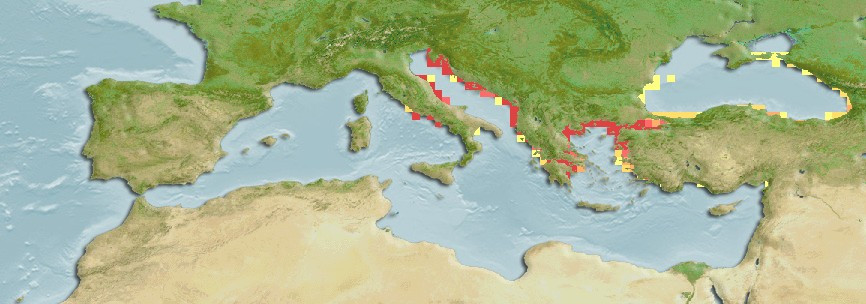
Microlipophrys adriaticus is a small fish belonging to the family Blenniidae. Its scientific name reflects its small size (‘micro‘) and its geographic distribution, especially in the Adriatic Sea. This species is mainly found along the rocky coasts of the Mediterranean Sea, including the Adriatic and parts of the northeastern Atlantic, typically inhabiting shallow waters between 0 and 3 meters deep, living in tide pools, rocky areas, and sometimes among algae.
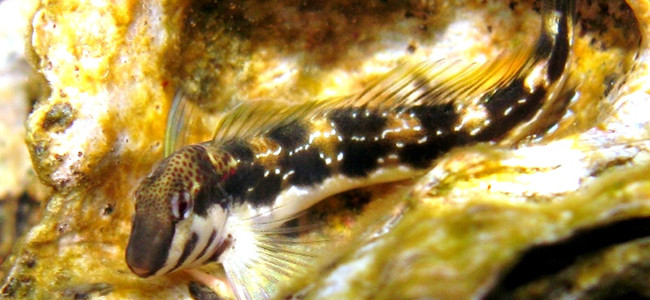
Morphologically, Microlipophrys adriaticus reaches a maximum length of about 4 cm. It has an elongated and laterally compressed body, typical of combtooth blennies. Its coloration varies depending on the environment, usually showing brown, gray, or greenish tones with dark spots that help it camouflage among rocks and algae. A distinctive feature of this species is the presence of small crests or tentacles above the eyes, known as cirri, which are useful for identifying combtooth blennies. It has a long, low dorsal fin running almost the entire length of the body and a broad head with a small upward-facing mouth. Compared to similar species like Lipophrys pholis, Microlipophrys adriaticus is smaller and has a less intense coloration, making it more discreet.
Regarding feeding habits, Microlipophrys adriaticus is omnivorous, feeding mainly on small marine invertebrates such as crustaceans, worms, and molluscs, as well as algae and plant matter scraped from rocks. Combtooth blennies are known for their active and curious behavior, and this species is no exception. It spends much of its time foraging on the rocky substrates of its habitat, using its small mouth to nibble algae and small organisms living in crevices.
Reproduction in Microlipophrys adriaticus is oviparous and generally occurs during spring and summer. Males defend small territories where they build nests in crevices or rock cavities. During the breeding season, males often develop brighter colors to attract females. After mating, females lay eggs in the nest, which the male guards and ventilates until they hatch. The eggs are adhesive and stick to rocky surfaces, and the male actively cares for them until the larvae are ready to swim freely.
An interesting fact about Microlipophrys adriaticus is its ability to survive out of water for short periods, an adaptation common in combtooth blennies living in intertidal zones. During low tide, this fish can remain in tide pools or even on wet rocks, using its skin to absorb oxygen and maintain limited activity until the tide rises. This behavior allows it to exploit ecological niches inaccessible to many other fish, providing an advantage in its intertidal habitat.
Photos:
 from
from