
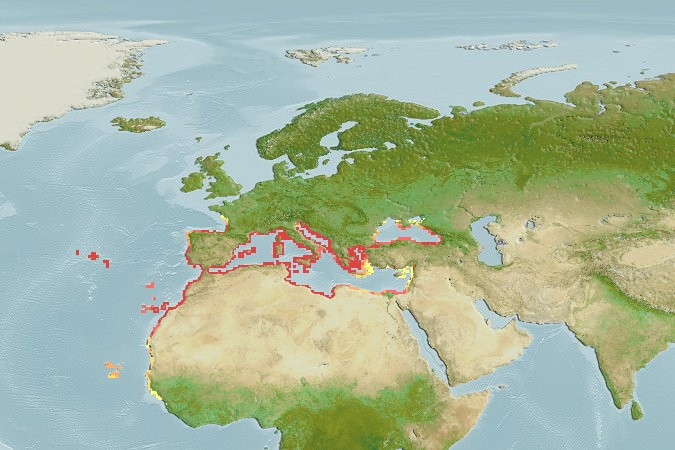
Parablennius sanguinolentus, commonly known as the ‘blacktail blenny‘, is a fish belonging to the family Blenniidae. Its scientific name comes from Latin, where ‘sanguinolentus‘ means ‘bloodstained‘ or ‘bloody‘, referring to the characteristic reddish marks on its body. It is found in coastal waters of the Mediterranean Sea and the Black Sea, as well as some areas of the eastern Atlantic, mainly in rocky areas and hard bottoms. It lives at depths ranging from 0 to 10 meters, preferably in intertidal zones where it seeks refuge in crevices, caves, and among algae.
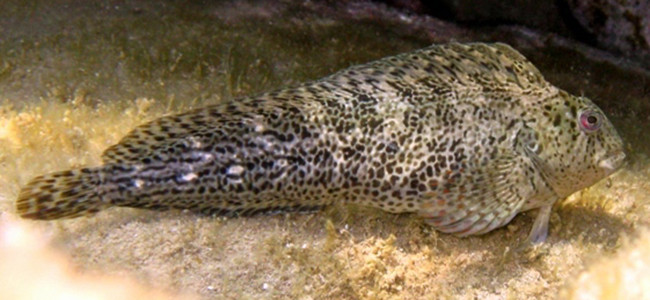
In terms of morphology, Parablennius sanguinolentus is a relatively small fish, with a maximum length between 10 and 15 cm. It has an elongated and laterally compressed body, a robust head, and a small mouth typical of blennies. Its coloration is predominantly brown, with various dark spots and, most distinctively, reddish spots that appear mainly on the gills and sides of the body, giving it its common name. Additionally, like other blennies, it has small cirri (filaments) above the eyes and nasal openings. The dorsal fin is long and runs along most of the body, while the pectoral fins are broad, providing great agility among the rocks. Compared to similar species such as Parablennius tentacularis, Parablennius sanguinolentus is distinguished by its reddish spots and smaller size.
Regarding its diet, Parablennius sanguinolentus is omnivorous, feeding mainly on algae and small marine invertebrates. It uses its small mouth and sharp teeth to scrape algae from rocky surfaces, complementing its diet with small crustaceans, worms, and other invertebrates found in its environment. Like many blennies, it has a generalist and opportunistic feeding behavior, allowing it to adapt well to changing habitat conditions.
Reproduction of Parablennius sanguinolentus is oviparous and usually takes place during spring and summer. During the breeding season, males develop brighter colors and defend territories where they prepare nests in rock cavities or crevices. Females lay their eggs in these nests, where males guard them until they hatch. Males ventilate the eggs with their pectoral fins and protect them from potential predators. Once larvae hatch, they disperse into the water column and go through a planktonic life stage before settling on the seabed as juveniles.
An interesting fact about Parablennius sanguinolentus is its territorial behavior. Despite its small size, males can become very aggressive during the breeding season, fiercely defending their nests against other males and competing species. Additionally, like other blennies, Parablennius sanguinolentus can survive low tide conditions by staying in intertidal pools or moist rocky areas, thanks to its ability to absorb oxygen through its skin. This behavior allows it to inhabit intertidal zones and survive harsh environments out of water for short periods.
Photos:
 from
from