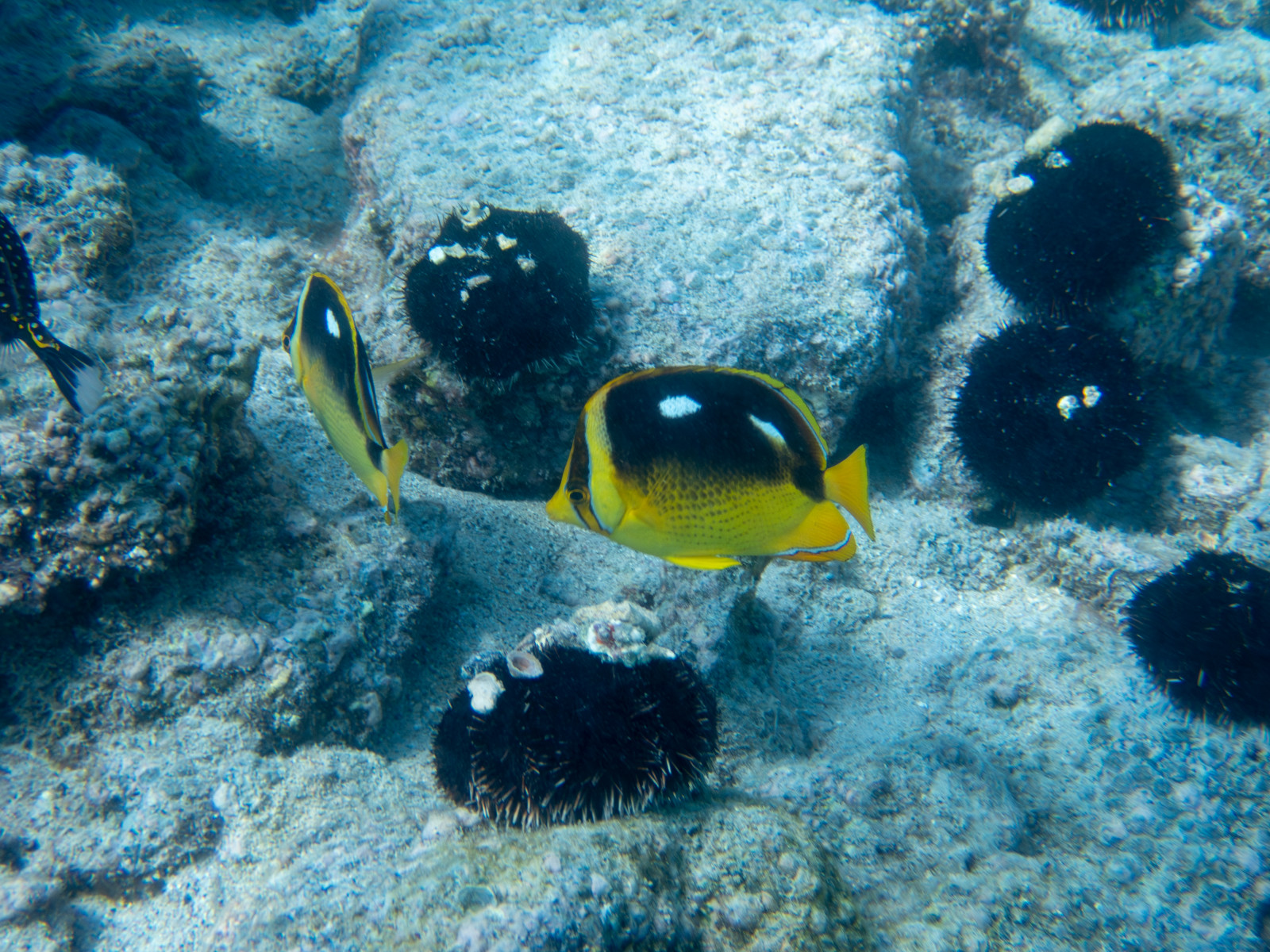
Chaetodon quadrimaculatus, commonly known as the fourspot butterflyfish, is a species of fish in the family Chaetodontidae. The genus name ‘Chaetodon‘ comes from the Greek ‘chaite‘ (hair) and ‘odous‘ (tooth), referring to the fine, bristle-like teeth characteristic of these fishes. The species name ‘quadrimaculatus‘ derives from Latin and means ‘four spots‘, alluding to the four distinctive dark marks on the sides of its body. This butterflyfish is native to the Indian and Pacific Oceans, distributed from the eastern coast of Africa, the Red Sea, and Indian Ocean islands, to the Hawaiian Islands, Marquesas, Ducie, and south to Australia’s Great Barrier Reef. It inhabits coral reefs, lagoons, and outer reef areas at depths ranging from 2 to 30 meters.

Chaetodon quadrimaculatus can reach up to 18 centimeters in length. Its body is laterally compressed and has the typical oval shape of butterflyfishes. The general body coloration is yellow, with a distinctive pattern of four black spots: two on the upper half of the body (one on each side), one along the dorsal fin margin, and a fourth at the base of the tail fin. Its head features a vertical black band crossing the eye, which helps confuse predators. The tail fin is pale yellow, while the pectoral and pelvic fins are translucent with yellow hues. Compared to similar species such as Chaetodon lunula, which also has spots, Chaetodon quadrimaculatus is distinguished by the exact number and placement of its spots.
Regarding its feeding habits, Chaetodon quadrimaculatus is a specialized feeder on coral polyps, especially those of the genus Acropora. It uses its small mouth, equipped with fine, bristle-like teeth, to pick polyps from coral colonies. Although its diet mainly consists of coral polyps, it may also consume other small invertebrates and algae. Its reliance on coral polyps as a primary food source makes it especially vulnerable to changes in reef health, such as coral bleaching and habitat degradation.
The reproduction of Chaetodon quadrimaculatus is oviparous. During the breeding season, usually in the warmer months, the fish form monogamous pairs that mate and defend territories within the coral reefs. Courtship involves synchronized movements and visual displays. The female releases eggs into the water column, where they are fertilized by the male. The eggs are pelagic and hatch into planktonic larvae that disperse in the ocean before settling on reefs as juveniles.
An interesting fact about Chaetodon quadrimaculatus is its highly territorial behavior and tendency to live in long-term pairs, suggesting strong monogamous bonds. Additionally, due to its specialized coral polyp diet, this fish serves as an important indicator of coral reef health. Declines in Chaetodon quadrimaculatus populations can reflect deterioration in coral cover, highlighting its ecological importance in reef ecosystems. Although popular in marine aquariums due to its attractive coloration, its strict coral-based diet makes it difficult to keep in captivity.
Photos: