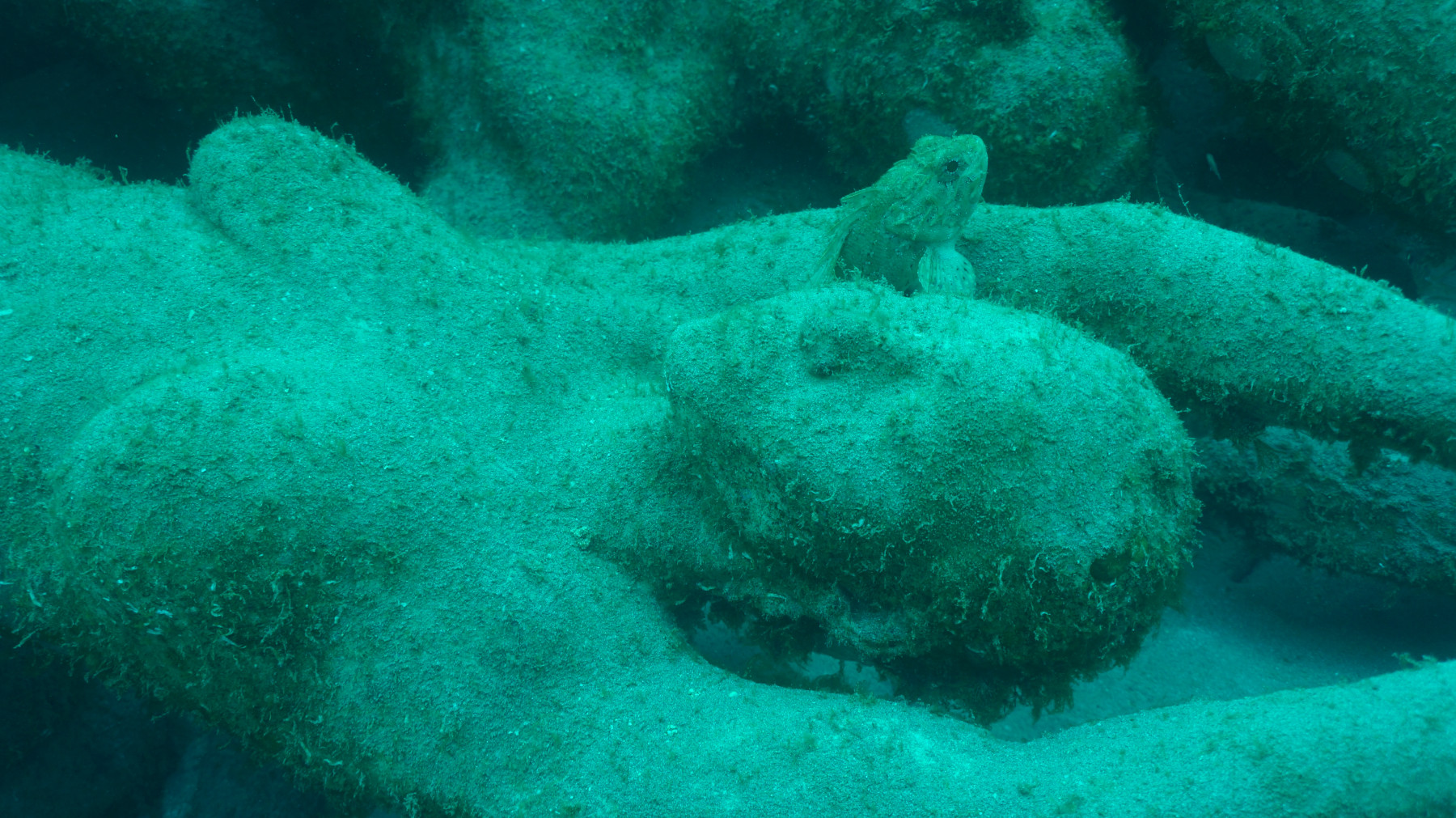
Within the order Scorpaeniformes and the family Scorpaenidae, we find Scorpaena maderensis. It is a species that lives in rocky environments near the coast of the Mediterranean Sea and in the eastern Atlantic Ocean where it is present in the Madeira, Azores, Canary and Cape Verde Islands. Specimens of this species can be found at depths between the surface and 40 meters.

The body of Scorpaena maderensis can reach a maximum total length of 15 cm. The body is robust and thick in the anterior part, and laterally compressed as we move to the posterior part of the body. The head is strong and robust with several spines. One of the distinctive features of this species is the absence of occipital fossette behind the eyes, so the cephalic profile is only interrupted by some spines on the head. The cutaneous appendages in this species are very poorly developed and may be present all over the body, including below the lower jaw. The dorsal fin of Scorpaena maderensis is unique, but two regions are easily distinguishable. A first one formed by 12 spines, followed by the second region formed by 9-10 soft rays. The anal fin has 3 spines and 5-6 soft rays, while the pectoral fins are wide and have the upper rays branched and the rest simple; the ventral fins are located in a relatively rear position, and the caudal takes a rounded shape.
As for the coloration of Scorpaena maderensis, the base color are different shades of brown and reddish, with small specks of white all over its body but especially around the axil of the pectoral fin. The pectoral fin has elongated dark spots, while the dorsal fin has brownish spots, and the caudal fin has a pair of dark vertical spots.
Scorpaena maderensis is a nocturnal species, which captures its prey unnoticed and immobile on the substrate, and when the prey is within its reach, it quickly pounces on it with an extremely fast and precise sucking movement of the mouth. Among the prey it feeds on are various species of crustaceans and other invertebrates, as well as small fish.
Scorpaena maderensis is often confused with other species of the same genus. To distinguish it, we must combine three features: the absence of an occipital pit, the small white appendages beneath the lower jaw, and the short appendages above the eyes.
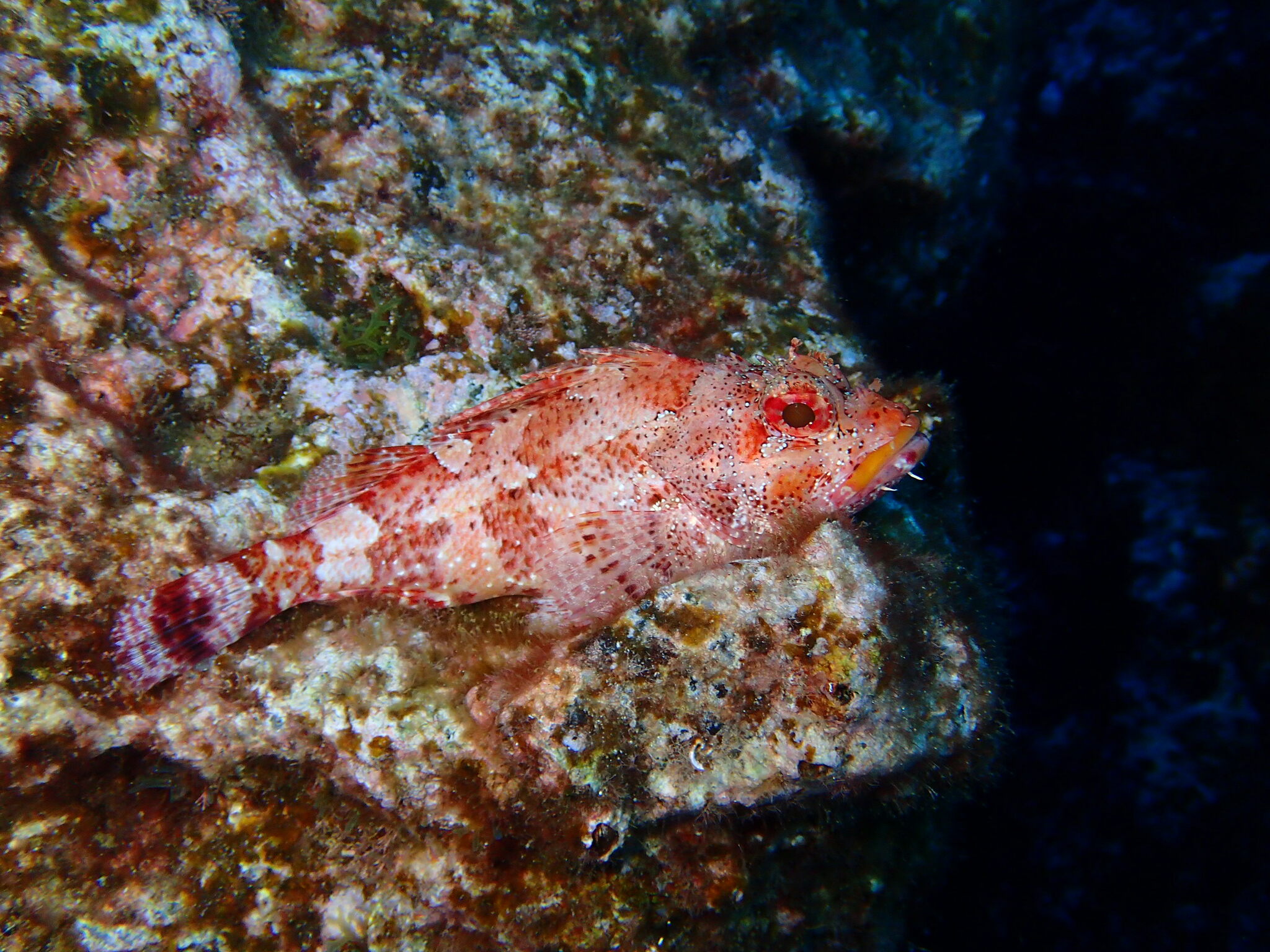
Crops and arrows added by Subdiversión.
-
Occipital pit absent.
It lacks the depression behind the eyes, before the origin of the dorsal fin. This feature distinguishes it from Scorpaena porcus, Scorpaena notata, and Scorpaena scrofa, which have an occipital pit. It should be assessed from an angle that reveals the contours of this region, without mistaking shadows for a depression. -
Small white appendages beneath the lower jaw.
There are two pairs of small white skin flaps beneath the lower jaw. They do not form the dense, irregular beard of Scorpaena scrofa. Their presence distinguishes it from Scorpaena porcus and Scorpaena notata, which lack appendages beneath the lower jaw. This region must be unobstructed to observe them. -
Short supraocular appendages.
The appendages above the eyes are short, measuring less than half the eye diameter. They contrast with the long appendages of Scorpaena porcus. On their own, they do not distinguish it from Scorpaena notata or Scorpaena scrofa; they must be considered together with the absence of an occipital pit and the small white appendages beneath the lower jaw.
Details to look for
The arrow indicates the area behind the eye where the absence of an occipital pit should be checked. This view helps locate the region, although an oblique view from above would make its contours easier to assess.
The arrow points to one of the white appendages projecting beneath the lower jaw. This view shows those on the visible side; it does not allow both complete pairs to be counted.
The arrow points to the appendage above the eye, whose size should be compared with the eye diameter. The nasal appendages are located farther forward, towards the snout.
Comparison with the other species
| Species | Appendages above the eyes | Appendages beneath the lower jaw | Occipital pit |
|---|---|---|---|
| Scorpaena maderensis | Short, measuring less than half the eye diameter | Two pairs of small white appendages, without forming a dense beard | Absent |
| Scorpaena notata | Very short or absent | Absent; no mandibular beard | Present |
| Scorpaena porcus | Long and prominent, approximately equal to or longer than the eye diameter | Absent; no mandibular beard | Present |
| Scorpaena scrofa | Generally small or absent; may be paddle-shaped | Numerous and well developed, forming an irregular beard | Present |
Photos: