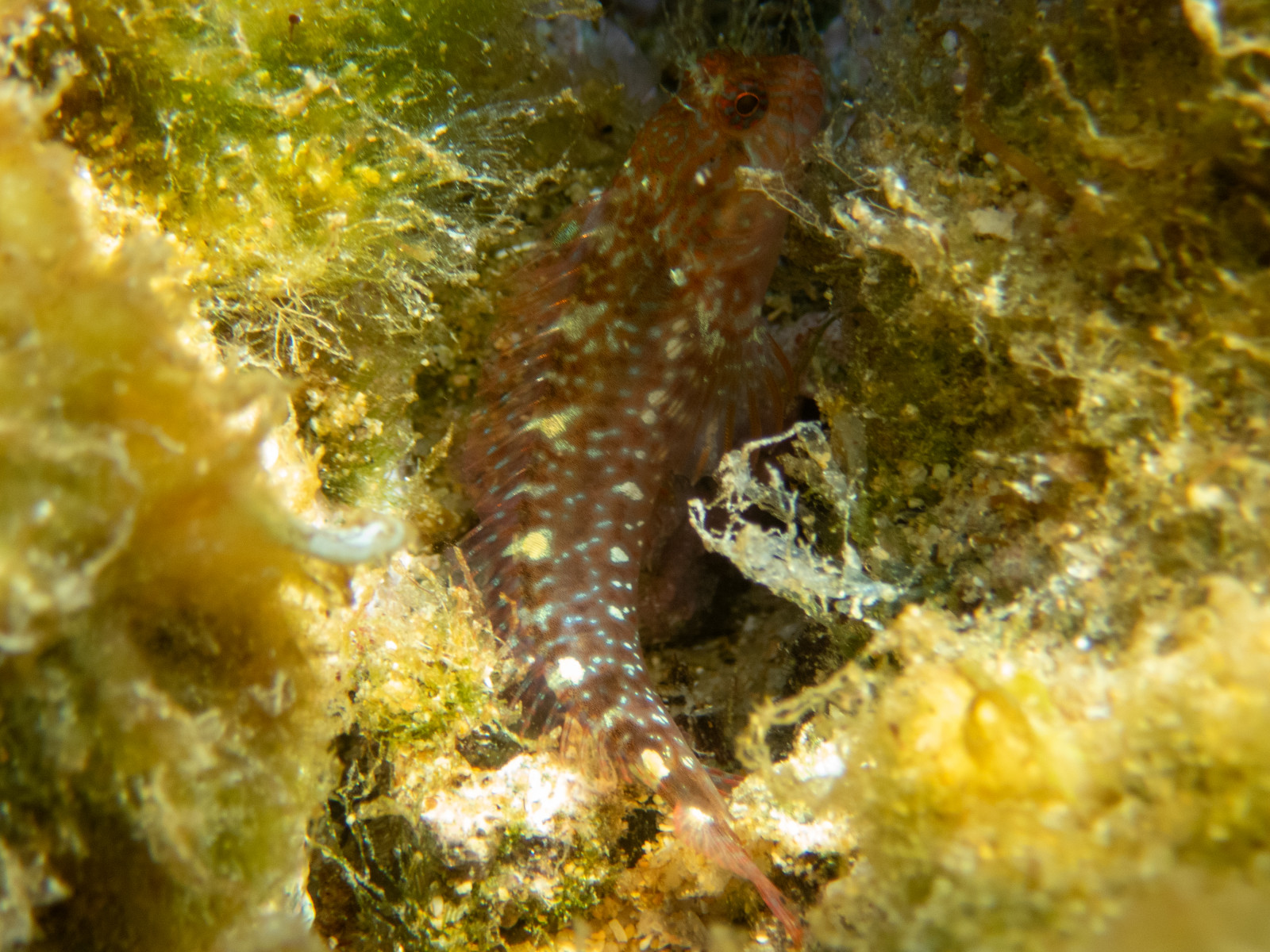
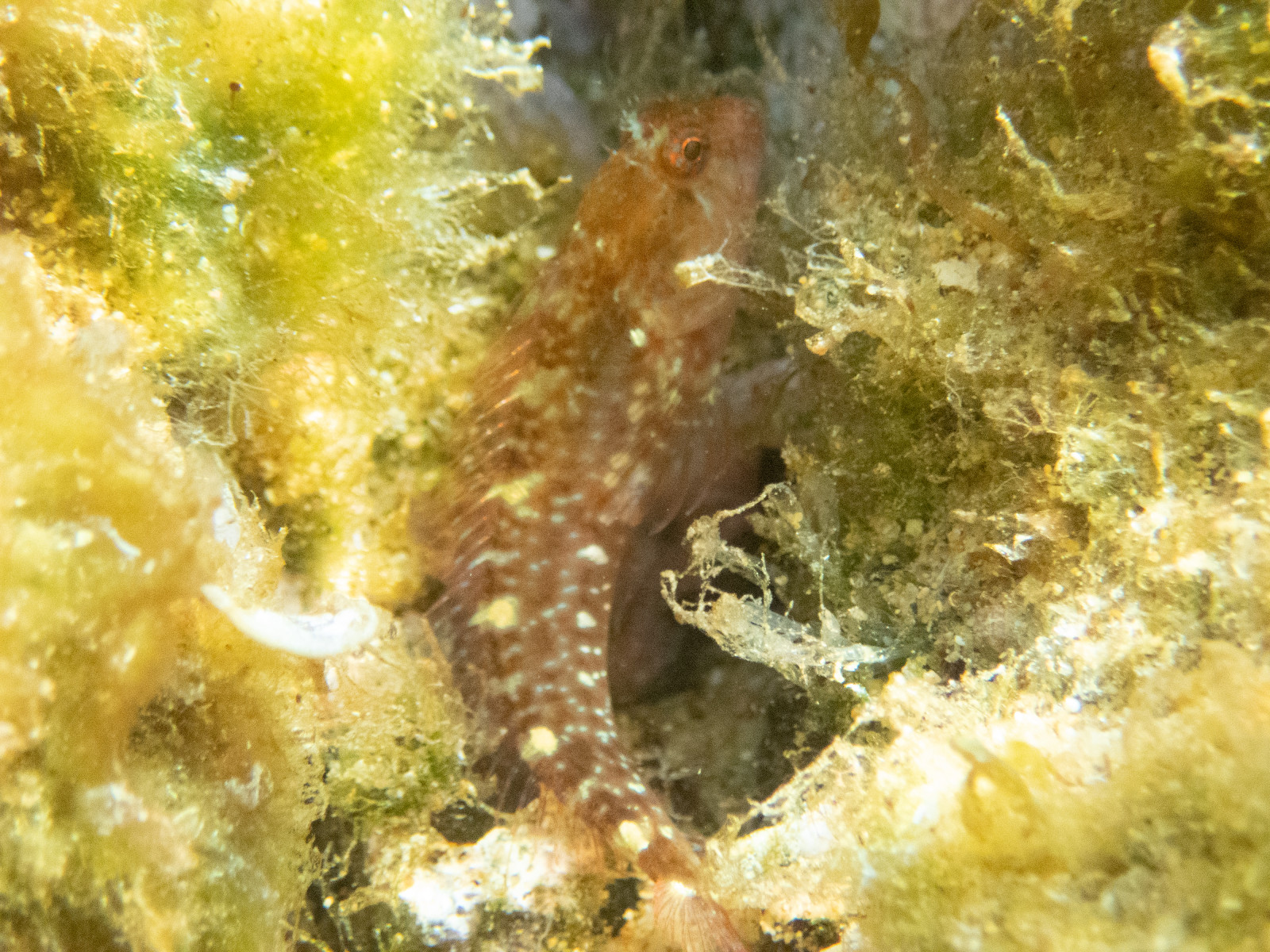
The blenny Parablennius zvonimiri is a species native to the Mediterranean and Black Seas, living in shallow coastal waters (2-10 meters) and on rocky bottoms with dim lighting, on vertical walls or near caves.
The body of Parablennius zvonimiri is elongated (less than 7 cm), slightly flattened laterally, with a slightly rounded head and an obtuse rostrum. As is common in blennid species, the skin of Parablennius zvonimiri lacks scales, and instead secretes a mucous substance. The species is characterized by the presence of medium-sized, branched and irregularly shaped supraocular tentacles (usually followed by small filaments behind the tentacles), as well as somewhat smaller tentacles on the nares. It has a single dorsal fin, with the spiny region (12 spines) and the soft region (18 soft rays) of approximately equal height and separated by a deep notch. The anal fin runs from about half the length of the body to the caudal peduncle, and consists of 2 spines followed by 19-20 soft rays. The pectoral fins are elliptical in shape and consist of 14 rays. The pelvic fins have one spine and 3 soft rays and are located in a jugular position. The body is reddish-brown, with some vertical blue lines on the rostrum. There is a series of 5 to 7 white spots along the back, just below the dorsal fin. Also very characteristic is a black spot located on the caudal fin.
During the months of May to July is when Parablennius zvonimiri specimens reproduce. The males court the females to attract them to their nests by a rocking motion of the head from side to side. If they are successful, both go to the hole where they will lay their clutches by attaching them to the substrate with an adhesive filament. From then on, the male will be the only one in charge of taking care of the clutch. It is very common for a male to take care of the clutches laid by several females in his nest.
The diet of Parablennius zvonimiri is very varied, finding among its main prey small benthic invertebrates such as isopods, amphipods, small shrimps, copepods and small molluscs.
To distinguish Parablennius zvonimiri, consider the series of pale spots along the base of the dorsal fin together with the additional small appendages on the head and nape. The bluish facial lines help identify it, but they are not exclusive to this species. Reddish coloration alone is not enough for identification.

-
Series of pale spots along the dorsal fin. Several white or cream spots occur along the back, larger than the small speckles on the flanks. Check their arrangement in a series along the base of the dorsal fin, without mistaking reflections for markings. This is a particularly useful clue when distinguishing it from Parablennius incognitus.
-
Additional small appendages on the head and nape. In addition to the branched tentacles above the eyes, there are smaller appendages on the head and nape. An oblique view from above is useful for finding them. Their presence, together with the dorsal spots, helps distinguish it from Parablennius incognitus.
-
Bluish facial lines. The head, jaws, and area around the eyes have pale bluish lines whose contrast depends on the lighting. These are a supporting feature: other species also have blue markings, so the previous two features should always be checked.
Details to look for
1. Pale spots along the back.
The arrow ends beside one of the spots, leaving its surface visible. Follow the series of larger markings and distinguish it from the small pale speckles on the body.

2. Nape region.
The arrow locates the area behind the supraocular tentacles where the additional small appendages should be sought. This image helps locate the region, although it does not resolve all the filaments or allow them to be counted.
3. Pale facial lines.
The arrow points to one of the lines on the cheek. Its appearance can vary from bluish to whitish depending on the light. This pattern should be used as a supporting feature, together with the dorsal spots and additional appendages.
Comparison with the most similar species
| Species | Tentacles and head | Usual body pattern | Feature to check |
|---|---|---|---|
| Parablennius zvonimiri | Branched supraocular tentacles and additional small appendages on the head and nape | Series of white or cream spots along the base of the dorsal fin | Consider the dorsal spots together with the additional small appendages |
| Parablennius incognitus | Tentacle with a longer anterior extension and several short posterior branches | Dark bars narrowed at the centre, forming an hourglass shape | Lacks the characteristic series of large pale dorsal spots found in P. zvonimiri |
| Parablennius pilicornis | Generally short, fork-shaped tentacles; net-like pattern on the cheeks | Highly variable: mottled, yellow, dark, or with a lateral stripe | Network of pale lines on the cheeks, considered together with the tentacle shape |
| Parablennius tentacularis | Main stem with numerous short posterior branches, approximately in a single plane | Dark dorsal blotches and lower bars that may alternate | Tentacle structure and dorsal fin without a deep notch |
The apparent absence of spots or appendages in a photograph may be due to the viewing angle, lighting, or the area being obscured. When the combination of features cannot be checked, identification should remain provisional.
Photos: