
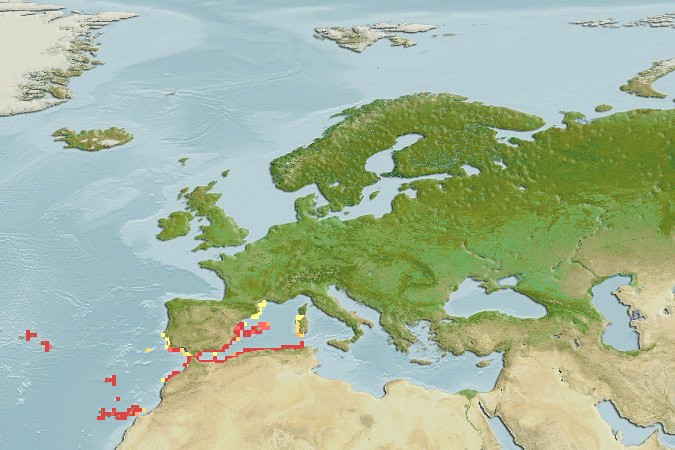
Serranus atricauda, commonly known as the blacktail comber or small grouper, is a fish belonging to the family Serranidae. Its scientific name derives from Latin: ‘Serranus‘ refers to its membership in the serranid family, and ‘atricauda‘ means ‘black tail‘, referring to the dark color of its caudal fin, one of its distinctive features. It is distributed in the eastern Atlantic, mainly along the coasts of the Iberian Peninsula, the Canary Islands, Madeira, the Azores, and the northern coast of Africa. It is also found in some parts of the western Mediterranean. It prefers rocky areas, underwater caves, and mixed sand-rock bottoms at depths ranging from 10 to 150 meters, although it is more commonly found in shallow waters.
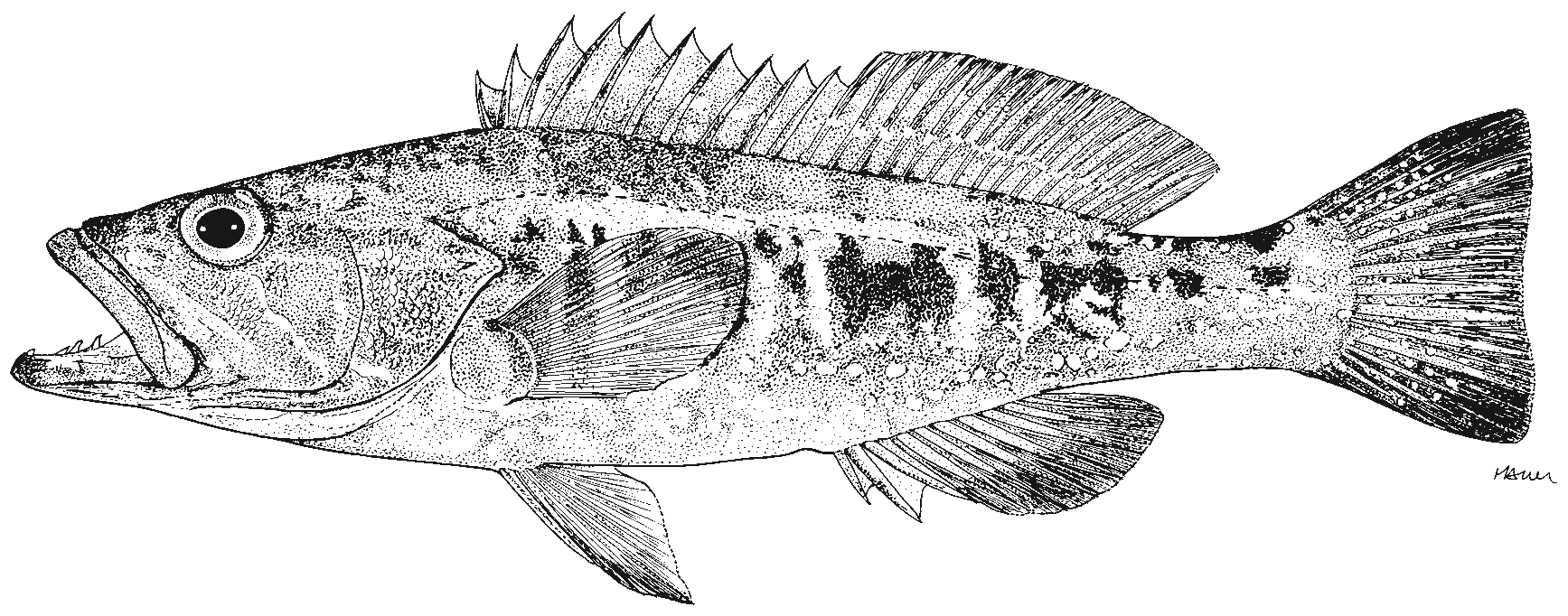
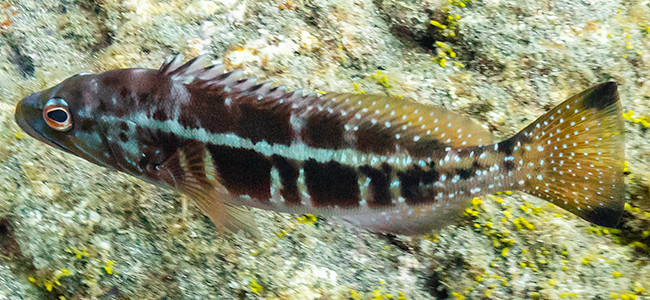
The Serranus atricauda has a robust, laterally compressed body that can reach up to 40 cm in length, though most individuals typically measure between 20 and 30 cm. Its general coloration is brown or grayish, with darker tones on the upper body and lighter tones on the belly. The most distinctive feature is its caudal fin, which is black or very dark, giving the species its specific name. It often displays dark vertical bands along its body, which become more evident when the fish is stressed or defensive. This coloration pattern helps it camouflage in rocky environments and blend with its habitat. It differs from other species of the genus Serranus, such as Serranus cabrilla, by the absence of reddish lateral lines and the darker caudal fin.
Regarding its diet, Serranus atricauda is an opportunistic carnivorous predator. Its diet mainly consists of small fish, crustaceans, and molluscs. It hunts by stalking, hiding among rocks and ambushing prey when they approach. It is also known as an active predator, searching for food on rocky and sandy bottoms during the day. Its feeding strategy adapts to the environment in which it lives, allowing it to exploit a variety of prey available in its habitat.
The reproductive behavior of Serranus atricauda is interesting because, like other species in the genus, it is a synchronous hermaphrodite, meaning each individual has both male and female reproductive organs simultaneously. During the breeding season, usually in spring and summer, individuals may act as either male or female depending on circumstances, maximizing their reproductive opportunities. Fertilization is external, and after spawning, eggs float freely in the water column until they hatch. The larvae are planktonic during early life stages before settling on the seabed.
An interesting fact about Serranus atricauda is its ability to adapt to different ecological niches within its rocky habitat. Due to its relatively small size compared to other serranids such as groupers, it does not directly compete with these larger predators, allowing it to survive in areas where food resources may be limited. Additionally, although it is a less known and less exploited species compared to other family members, Serranus atricauda holds some value in sport and recreational fishing, especially in the Canary Islands and Madeira, where it is prized for its white, tasty flesh.
Photos:
 from
from