
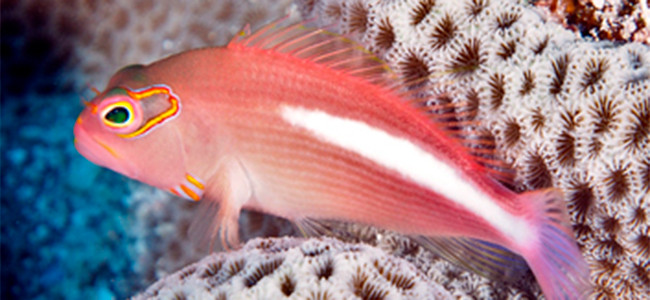
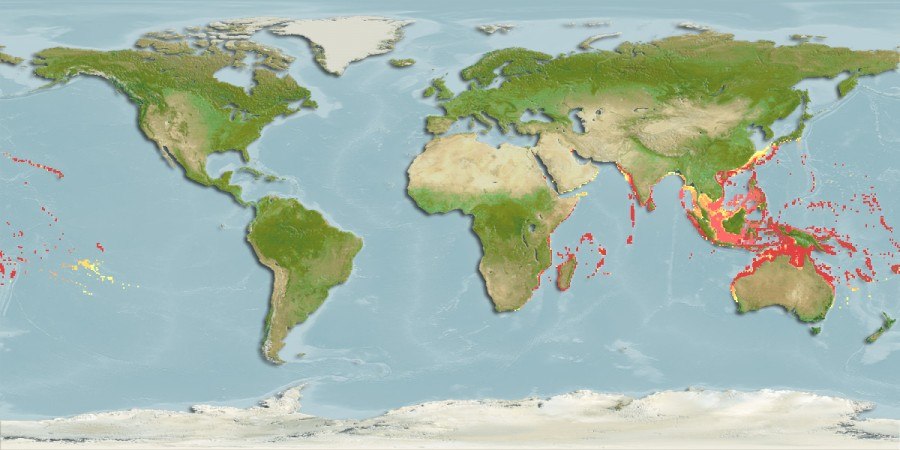
Paracirrhites arcatus, commonly known as the arc-eye hawkfish, is a marine fish species belonging to the family Cirrhitidae, within the order Perciformes. Its name derives from Greek and Latin: Paracirrhites means ‘beside Cirrhites‘, while arcatus comes from Latin meaning ‘arched‘, likely referring to the distinctive horseshoe-shaped pattern around its eye. This species is widely distributed throughout the tropical Indo-Pacific, from the eastern African coast to the Hawaiian Islands, Japan, Australia, and other Pacific islands such as the Line Islands and Mangareva. It inhabits coral reefs, both in lagoons and outer reef zones, at depths between 1 and 91 meters, though it is most commonly found between 1 and 35 meters, associated with corals of the genera Stylophora, Pocillopora, and Acropora.
The Paracirrhites arcatus has a robust and slightly laterally compressed body, reaching a maximum recorded length of 20 cm. Its coloration is highly variable but is always distinguished by an orange arc-shaped mark behind the eye, along with three orange bands on a light blue background in the opercular region. A white or pinkish stripe commonly extends from the middle of the body to the base of the tail. It has 10 spines and 11 soft rays in the dorsal fin, each spine crowned with a small branched cirrus, while the anal fin has 3 spines and 6 soft rays. Unlike similar species such as Paracirrhites forsteri, which also displays a lateral stripe, Paracirrhites arcatus is easily identified by its distinctive horseshoe eye mark and the tricolor pattern around the gill region.
It is a carnivorous fish with opportunistic feeding habits. Its diet mainly consists of shrimps, small fish, crabs, and other crustaceans. Thanks to its territorial behavior and ability to remain motionless on coral branches, it strategically positions itself to ambush prey. This behavior has earned it the nickname ‘hawkfish’, due to its resemblance to the way a hawk watches and attacks from above.
The Paracirrhites arcatus is an oviparous species that reproduces in open water. During the breeding season, which coincides with spring, it forms breeding pairs that briefly ascend in the water column to release and fertilize gametes. This behavior is common among fish of the genus Paracirrhites and allows greater larval dispersal. The species also exhibits polygamous behavior and maintains territories that it actively defends against other individuals.
An intriguing fact about Paracirrhites arcatus is that it lacks a swim bladder, preventing it from floating passively. This adaptation allows it to stay firmly perched on corals, even in the presence of currents. Additionally, its large scaleless pectoral fins enable it to rest on stinging corals without injury, a rare ability among bony fishes. It is usually solitary and highly territorial, though it can also be seen in pairs during reproduction. Its main predators in French Polynesia include the grouper Cephalopholis argus. Although no documented symbiotic relationships exist, its close association with corals like Stylophora and Pocillopora is crucial for its protection and lifestyle.
Photos:
 from
from